Twin assaults leave 38 soldiers dead in Niger’s escalating conflict
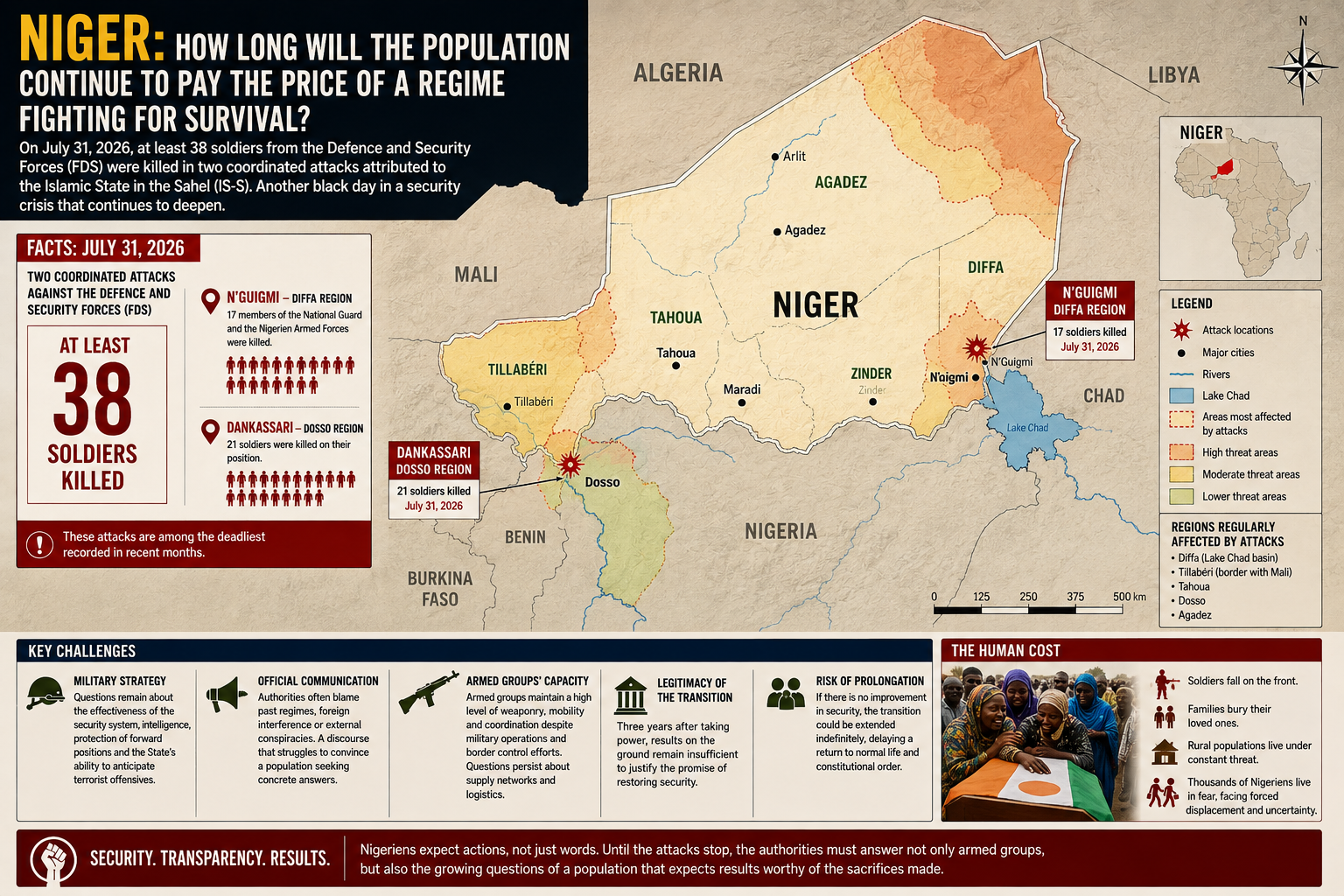
July 31, 2026, marks another grim milestone in Niger’s ongoing security crisis, as coordinated assaults by the Islamic State in the Sahel (IS-Sahel) claimed the lives of at least 38 military personnel. The attacks, unfolding within hours of each other, targeted positions in N’Guigmi (Diffa region) and Dankassari (Dosso region), leaving 17 members of the National Guard and Nigerien Armed Forces dead in the first strike, followed by 21 more in the second.
These raids rank among the deadliest in recent months, underscoring a troubling trend: while the human cost mounts, terrorist groups persist in expanding their reach across the country. For civilians and soldiers alike, the question looms larger than ever: how long will Niger’s population bear the burden of a security crisis that shows no signs of abating?
From coup to crisis: promises unfulfilled
When General Abdourahamane Tiani seized power, the justification hinged on a single, urgent imperative: reversing Niger’s spiraling security collapse under civilian rule. The military’s stated mission was clear—restore territorial control, dismantle armed groups, and safeguard communities. Yet three years into the transition, the reality paints a starkly different picture.
The violence has not waned. Instead, attacks now scar regions long considered hotspots—Tillabéri, Tahoua, Dosso, and the Lake Chad basin—while armed factions demonstrate alarming operational sophistication in executing large-scale offensives. Despite repeated pledges to reorganize the defense apparatus, the state’s ability to preempt or contain such threats remains in question.
Military setbacks raise hard questions
Each attack now transcends its immediate human toll, exposing systemic flaws in Niger’s security architecture. Military intelligence gaps, vulnerabilities in forward operating positions, and the persistent challenge of anticipating jihadist movements have become recurring themes. As casualties rise, so does public skepticism toward the junta’s strategy.
Critics argue that the allocation of resources between political consolidation and battlefield readiness may be misaligned. For a regime whose legitimacy hinges on delivering security, the absence of tangible progress risks eroding trust at a critical juncture.
Official narratives fail to silence doubt
In the aftermath of each assault, authorities frequently deflect blame toward historical failures, foreign interference, or external actors. While geopolitical complexities undoubtedly play a role, such explanations do little to address the immediate concerns of affected families and communities.
What the public seeks are concrete answers: Where did operational failures occur? What corrective measures are being implemented? How will future tragedies be prevented? As attacks multiply, the disconnect between rhetoric and action risks further alienating a population already weary of empty assurances.
An insurgency that defies containment
The resilience of armed groups—despite military operations and border enforcement—has become a defining challenge. Their access to advanced weaponry, logistical networks, and coordinated tactics suggests deep-rooted supply chains and intelligence failings that persist despite state efforts. Without transparent disclosures, speculation flourishes, deepening the rift between citizens and institutions.
A transition at risk of losing its footing
The junta’s survival hinges on its ability to fulfill its founding pledge: restoring security. Yet with each new attack, that promise grows harder to uphold. The human toll—displaced families, shattered communities, and mounting civilian casualties—undermines any hope of a swift return to constitutional order. Instead, the crisis fuels debates over whether prolonged instability might indefinitely prolong the transition, demanding urgent accountability and a credible roadmap for resolution.
The human cost of a stalled fight
Beyond political calculations, the starkest reality remains unchanged: soldiers are dying in defense of their nation, families are burying their loved ones, and rural populations endure life under the shadow of armed groups. For thousands of Nigeriens, daily existence is dictated by fear, displacement, and uncertainty.
The security crisis, once framed as the justification for military rule, now stands as its most unforgiving test. Until the tide turns, the authorities must confront not only the insurgency but also the growing chorus of a people demanding results commensurate with the sacrifices they have made.