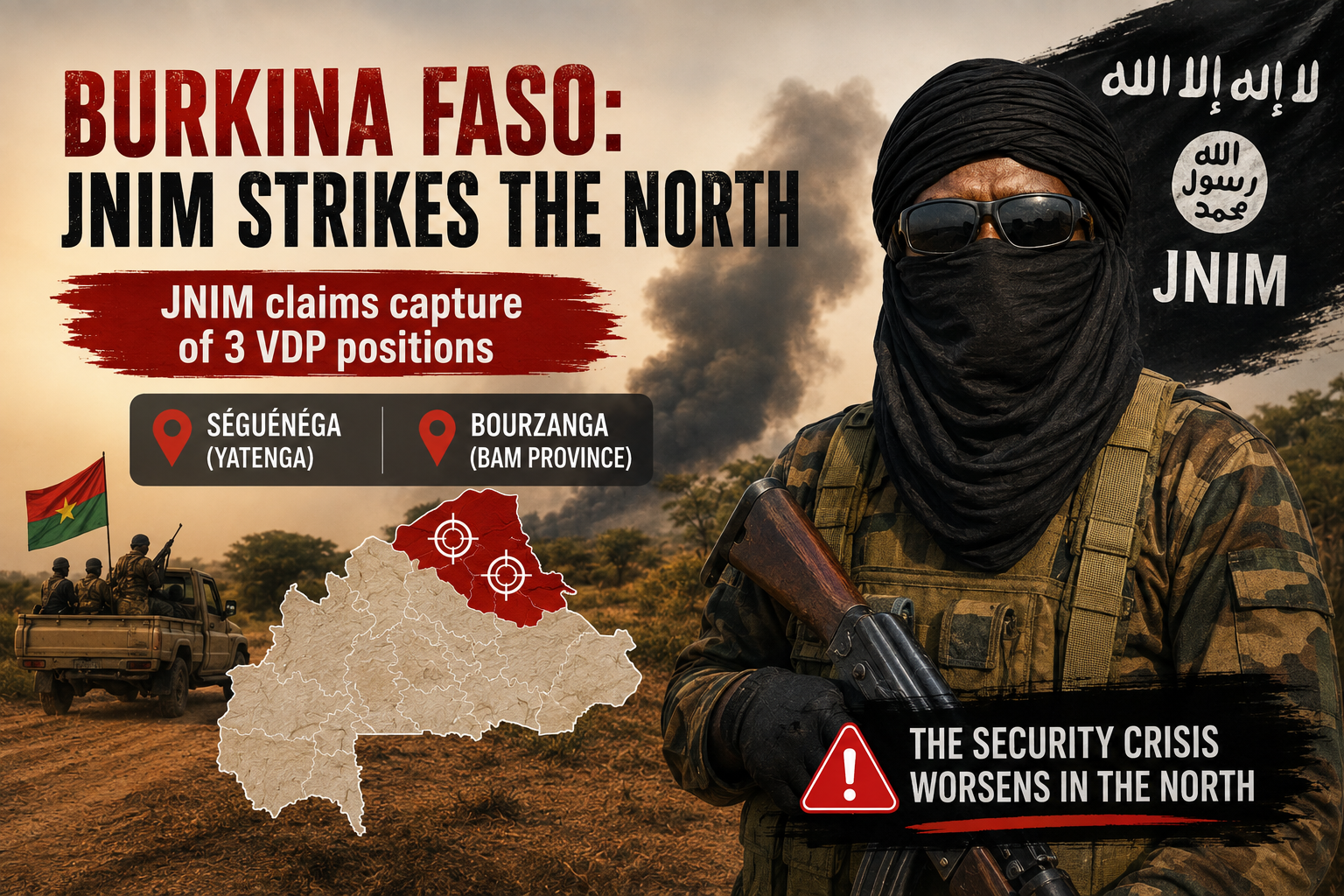
The ongoing security crisis in Burkina Faso continues to inflict severe hardship on its population, while the government’s communication strategy faces mounting scrutiny. On August 19, the Group for the Support of Islam and Muslims (JNIM) claimed responsibility for seizing three strategic positions held by the Volunteers for the Defense of the Homeland (VDP) in the northern region. The attacks, marked by extreme violence, targeted Séguénéga in the Yatenga province and Bourzanga in the Bam province, further underscoring the deteriorating situation on the ground.
Strategic setbacks and their far-reaching consequences
This latest assault raises serious questions about the ability of government forces to maintain control over recently secured zones. The frequent attacks, relentless pressure on local communities, and persistent vulnerabilities of key outposts demonstrate that military operations alone are insufficient. A sustainable solution requires not only robust security measures but also a visible state presence, reliable intelligence, logistical support, and above all, tangible protection for civilians.
The situation is exacerbated by the critical role played by the VDP, who are heavily relied upon in Burkina Faso’s security framework. Operating on the front lines against well-armed and highly mobile extremist groups, the VDP face immense challenges. Each territorial loss not only weakens military credibility but also erodes public trust, triggers mass displacements, and obstructs humanitarian access.
Ibrahim Traoré’s leadership under scrutiny
Amid this escalating crisis, the responses from Captain Ibrahim Traoré, leader of the country’s transitional government, have raised concerns. Rather than addressing systemic security failures through coherent and constructive dialogue, his administration has resorted to disjointed media statements laced with populist rhetoric. These communications appear to prioritize deflection over substance, offering little more than superficial reassurance to an increasingly frustrated population grappling with daily insecurity.
Yet in a crisis of this magnitude, political messaging cannot replace tangible action. While calls for sovereignty, resilience, and diplomatic shifts may resonate with certain segments of the public, they do not shield villages, secure roads, or prevent assaults on military and civilian positions. What citizens urgently demand are measurable improvements in their safety and living conditions.
The core issue is no longer about the narrative propagated by the authorities, but whether real change is occurring in the daily lives of Burkinabè people. When entire communities remain exposed, villages are abandoned, or strategic positions fall despite significant deployment of resources, the discourse falls short of reality. The problem transcends communication it reflects the effectiveness of the government’s security strategy and its commitment to fulfilling promises made to the population.
Censorship and the silencing of dissent
An equally troubling development is the severe curtailment of freedom of expression in Burkina Faso. Once a vibrant and critical media landscape, the press now operates under heavy restrictions. Journalists and independent voices attempting to investigate or report on the crisis face systematic repression: censorship, arbitrary detention, forced relocation to so-called “re-education” camps, or coerced deployment to frontline zones under the guise of patriotism. These actions punish truth-telling, stifling vital public discourse.
In any conflict, independent journalism serves as a crucial mechanism for documenting progress, exposing vulnerabilities, and alerting to humanitarian needs. Silencing these voices does not make the problems vanish; it widens the gap between official narratives and ground realities, fostering distrust and obscuring the path to genuine resolution.
The government may appear to control the national narrative, but it cannot control the facts on the ground. Attacks continue, civilians continue to flee, and lives continue to be lost realities that institutional communications cannot indefinitely obscure.
The trap of narrative control
The paradox is stark: as the security situation demands greater transparency, accountability, and open debate, the space for critical discourse shrinks. Yet, an effective crisis response requires the ability to acknowledge setbacks, analyze failures, and adapt strategies promptly. Suppressing dissent may provide short-term political comfort, but it denies policymakers access to essential information needed to refine their approach.
By restricting access to free and independent information, the authorities confine themselves to a dangerous state of denial one that delays meaningful action but does nothing to resolve the urgency of the crisis. Combating terrorism demands not only strength and mobilization but also transparency, accountability, and a willingness to confront harsh truths.
Ultimately, the true benchmark for success remains the safety of the people. As long as armed groups continue to inflict damage, gain territory, or maintain pressure on vulnerable regions, the government must accept scrutiny over the outcomes of its policies. Political messaging can sway public perception; it cannot, however, win a war against terrorism on its own.