Senegal’s President removes Prime Minister Ousmane Sonko
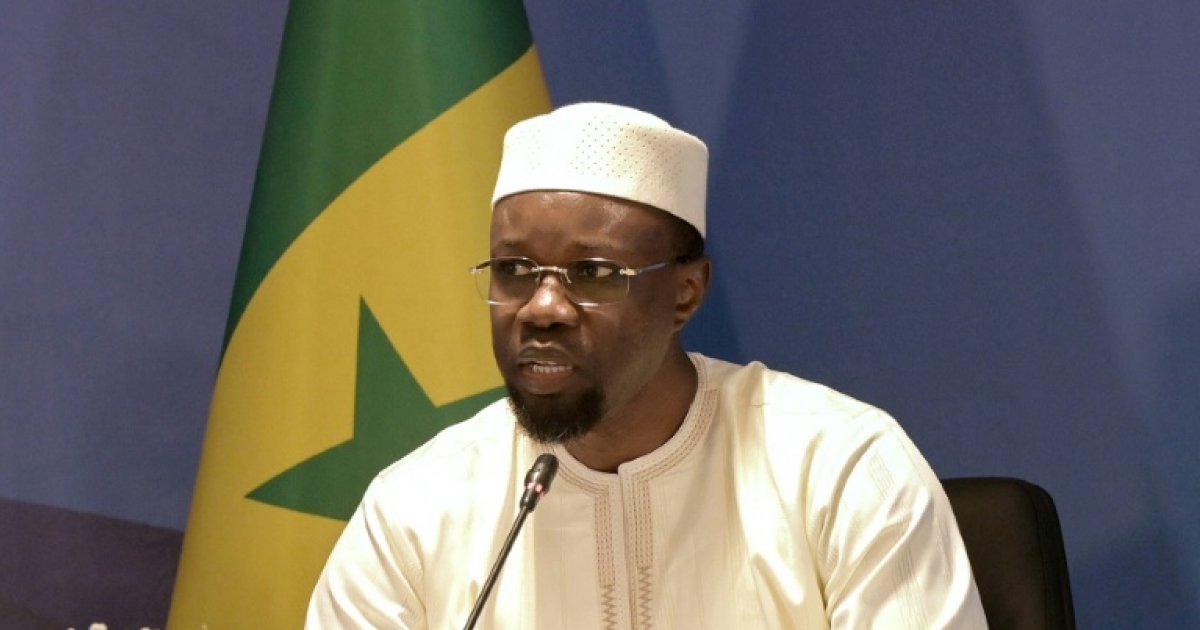
President Bassirou Diomaye Faye of Senegal has announced the dismissal of Prime Minister Ousmane Sonko, an erstwhile political ally and mentor. This significant decision, made on Friday evening, follows several months of escalating tensions between the two leaders who ascended to power in April 2024, riding a wave of immense public hope.
The presidential decree, read aloud on national television by Oumar Samba Ba, the Secretary-General of the Presidency, stated that President Faye had “ended the functions of Mr. Ousmane Sonko, Prime Minister, and consequently those of the ministers and secretaries of state who were members of the government.”
The statement further clarified that “the members of the outgoing government are tasked with handling current affairs.” As of now, no successor to the prime ministerial post has been named.
Since their election, a noticeable strain has developed between President Faye and his influential former mentor, Ousmane Sonko, whose considerable charisma and political sway were instrumental in propelling their joint ticket to victory.
Sonko, a vocal adversary of former President Macky Sall (2012-2024), was barred from running in the 2024 presidential election after a defamation conviction stripped him of his civil rights. It was then that Sonko designated Bassirou Diomaye Faye to take his place in the presidential race.
With a compelling pan-Africanist message, Ousmane Sonko galvanized disillusioned Senegalese youth in the lead-up to the elections. This came after a protracted standoff with Macky Sall’s government, which had violently suppressed protests against Sonko and the possibility of Sall seeking a third term.
Fresh out of prison following an amnesty law designed to ease years of political unrest, the two leaders campaigned under the powerful slogan “Diomaye Moy Sonko,” which translates from Wolof as “Diomaye is Sonko.”
– Spontaneous Gathering –
Reacting swiftly to the news, Mr. Sonko took to his Facebook account, stating, “Alhamdoulillah. Tonight I will sleep with a light heart in Cité Keur Gorgui,” referring to his Dakar residence. Journalists present observed hundreds of Sonko’s supporters converging on his home Friday evening, cheering him on after the announcement of his removal from government.
Earlier in the day, the now-former Prime Minister had criticized what he termed the “tyranny” of the West, which he claimed sought to “impose (homosexuality) on the rest of the world” during a parliamentary address. This statement followed weeks after the adoption of a law increasing penalties for homosexual relations in the predominantly Muslim West African nation.
Over the past few months, the underlying tensions between the head of state and the head of government had become increasingly apparent, making their continued cooperation seem ever more improbable.
At the beginning of the month, President Faye had openly criticized his Prime Minister’s “excessive personalization” within the ruling party.
In a televised interview, President Faye had stated, “As long as he remains Prime Minister, it is because he has my trust. When that is no longer the case, there will be a new Prime Minister.”
Mr. Sonko’s party has held a significant majority in the Senegalese National Assembly since its landslide victory in the legislative elections of November 2024.
Weeks prior, parliament paved the way for Ousmane Sonko’s potential candidacy in the next presidential election in 2029 by adopting an electoral code reform, which was subsequently promulgated by the President. Opposition factions, however, decried the law as solely benefiting Mr. Sonko.
In July 2025, Senegal’s Supreme Court rejected an appeal by Mr. Sonko, who was then Prime Minister since April 2024, against his conviction, reigniting debates surrounding his eligibility. Nevertheless, Sonko was elected as a deputy in the November 2024 legislative elections before resigning his mandate to remain Prime Minister, a move his party interprets as affirming his eligibility. Local elections are slated for 2027, preceding the 2029 presidential contest.
While Mr. Faye may not command the same level of popular fervor as the Pastef leader, he has steadily garnered support over recent months through the “Diomaye Président” movement, signaling a potential bid for the 2029 presidency.
Upon assuming office, the nation’s leaders were confronted with a daunting economic landscape, inheriting a substantial debt from the previous administration. According to the International Monetary Fund (FMI), this debt stands at an alarming 132% of its GDP, positioning Senegal as the second most indebted nation in Sub-Saharan Africa.
In 2024, the new government, formed after the opposition’s electoral triumph, accused the former President Macky Sall’s administration of concealing the true extent of this worrying budgetary situation. This revelation ultimately led to the suspension of a $1.8 billion FMI aid program.