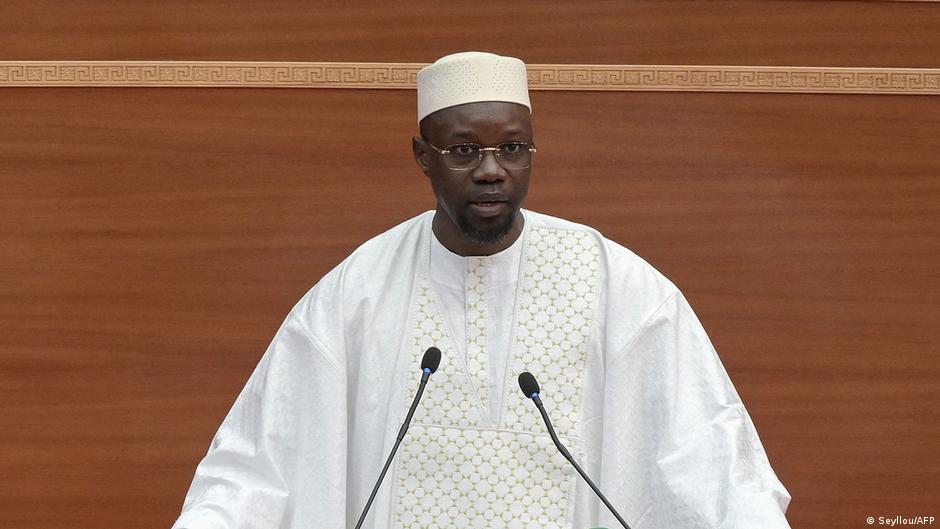
Ousmane Sonko set to take helm of Senegal’s National Assembly
Outside Ousmane Sonko’s residence in Cité Keur Gorgui in Dakar, a Pastef-Les Patriotes party activist shouts his name, rallying support for the detained leader. The slogan “Diomaye is Sonko—Senko is Diomaye” resonated across Senegal during the campaign, reflecting the deep bond between President Bassirou Diomaye Faye and his mentor.
Nourdine Diallo, a long-time campaigner, expresses dismay at the recent political rupture. “It hurt deeply when the president dismissed the prime minister. We campaigned on that slogan because it reflected our reality—not just empty words. We told Senegalese that Diomaye and Sonko are brothers, bound by party ties and shared institutional vision.”
Institutional showdown looms over National Assembly
Ousmane Sonko’s dismissal as prime minister followed his sharp questioning of government policy in the National Assembly. Now, a high-stakes institutional clash is brewing ahead of Tuesday’s session, where deputies will vote on two critical issues: reinstating Sonko as a deputy and electing a new speaker to replace the recently resigned El Hadj Malick Ndiaye.
Sonko’s return to parliament seems almost certain, which would position him as the second-ranking official in the state. But this shift could trigger a direct confrontation between the former allies, warns political analyst Malao Kanté.
“Ousmane Sonko now embodies the face of the opposition, yet his party holds the parliamentary majority. This paradox carries risks. A motion of no confidence against the next prime minister looms, threatening to paralyze state functions and plunge Senegal into uncertainty.”
Opposition slams constitutional overreach
Party officials insist the reinstatement process violates constitutional norms. Pastef-Les Patriotes strategist Adama Fall draws parallels to historical power struggles in Africa but insists this generation will rewrite the narrative.
“We’ve seen this story before—Burkina Faso’s Blaise Compaoré and Thomas Sankara, Congo’s Patrice Lumumba, even Senegal’s Mamadou Dia and Léopold Sédar Senghor. But today’s generation is different. We won’t repeat the mistakes of the past. We will correct them.”
Sonko’s possible ascension comes amid mass resignations within his party. Several senior officials have stepped down in solidarity, and the opposition caucus has formally rejected El Hadj Malick Ndiaye’s resignation as speaker, calling it procedurally invalid.
Women’s caucus leader Aïssata Tall Sall has urged President Faye to challenge Sonko’s reinstatement before the Constitutional Council, labeling it a constitutional coup. She warns that inaction risks emboldening Sonko to challenge the presidency itself.
The president, facing pressure, has appointed economist and former BCEAO official Ahmadou Al Aminou Mohamed Lô as the new prime minister. Lô, a former minister in the presidency, has called for national mobilization, declaring that Senegal stands at a decisive turning point.