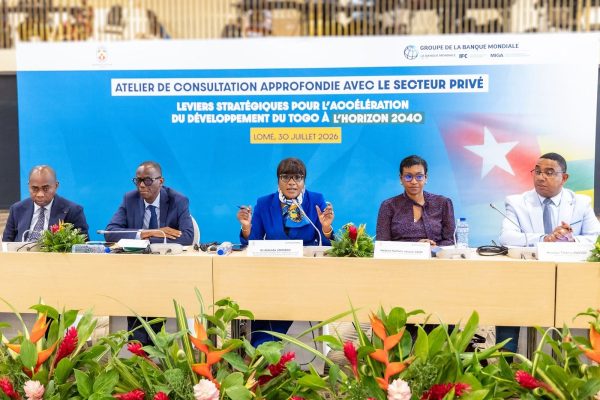
Lomé, 31 july 2026 — Togo is placing private investors and businesses at the forefront of its long-term economic ambitions. On thursday 30 july, key economic players gathered in the capital to address a pressing question: how can the private sector become a cornerstone of the country’s expected economic transformation in the coming years?
The workshop focused on Vision Togo 2040 and the government’s 2026–2031 roadmap brought together representatives from the World Bank Group, the private sector employers’ federation, the chamber of commerce and industry, major Togolese enterprises, and international experts. The event was inaugurated by Sandra Ablamba Johnson, minister and secretary-general of the Presidency of the Council, acting on behalf of president Faure Essozimna Gnassingbé.
A bold economic vision
At the heart of the discussions lies a far-reaching ambition: by 2040, Togo aims to double the average standard of living and reduce poverty to below 15%. Achieving these goals will require leveraging the private sector’s capacity for investment and job creation more effectively.
The government acknowledges that public resources alone cannot shoulder the burden of such a sweeping economic transformation. The strategy hinges on attracting more capital, nurturing local businesses, and fostering an investment climate that encourages growth and innovation.
From vision to actionable steps
The workshop’s primary goal was to identify the concrete measures needed to elevate the private sector from an economic player to a full-fledged partner in public policy. Key areas of focus included improving investment conditions, supporting business development, mobilising capital, and stimulating new productive activities.
The inclusion of the World Bank and international experts lent the discussions a broader perspective, enabling a comparison of Togo’s strategic direction with best practices from other economies. This exchange aimed to refine national priorities and translate them into tangible initiatives under the Vision Togo 2040 framework.
The private sector’s pivotal role
The message from Lomé was unequivocal: the next phase of Togolese development must place private enterprise and investment at its core. This gathering marked a pivotal moment in shaping a new growth model, with the ultimate aim of significantly enhancing living standards by 2040.
For Togolese authorities, the challenge now is to move from ambition to action—transforming strategic plans into decisive policies, and those policies into measurable economic and social outcomes. Only then can the country’s long-term goals transition from visionary projections to tangible reality.