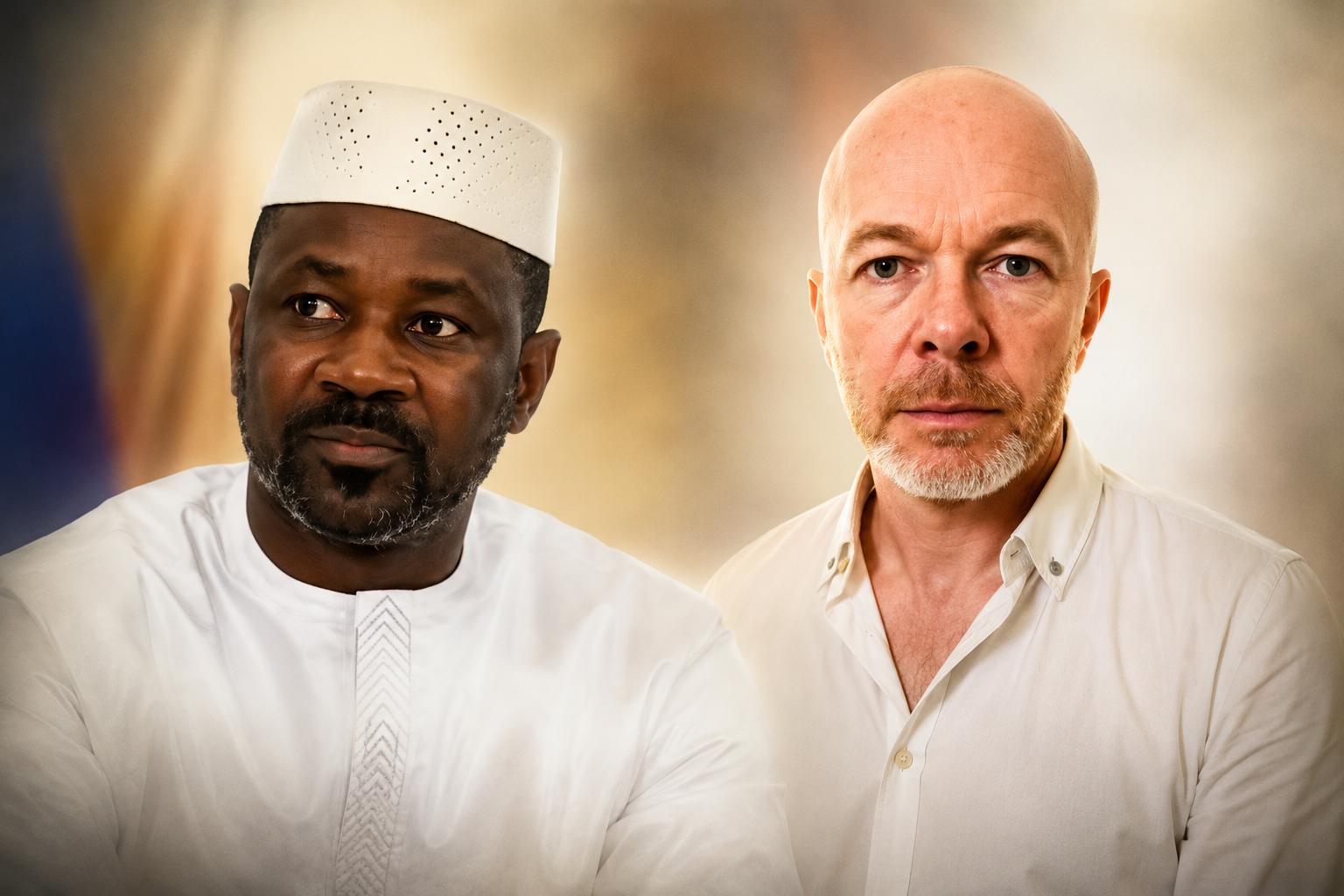
The announcement came with the customary trappings of state sovereignty: General Assimi Goïta granted a presidential pardon to Yann Vézilier, the French intelligence officer detained in Bamako a year prior. Recently sentenced to twenty years in prison for alleged « attempts to destabilize » the country, the shadow diplomat is now set to return to French soil. Yet while Mali’s transitional authorities frame this resolution as an act of magnanimity and national forgiveness, the circumstances surrounding his case tell a far more complex story.
Behind the spectacle: a trial designed for domestic consumption
The swift and severe verdict delivered in June was never merely a judicial decision—it was a calculated political performance. From the moment of his arrest in August 2025, Yann Vézilier’s fate was never left to chance. As a diplomat accredited to local authorities, his presence was no secret to Mali’s security apparatus. His abrupt reclassification as a « conspirator » was a deliberate move, aimed at redirecting national frustration toward an external scapegoat and reinforcing unity under the military regime.
The twenty-year sentence was engineered with two goals in mind: to project an image of unyielding justice capable of defying Mali’s former colonial power, and to create a high-stakes diplomatic bargaining chip. The courtroom theatrics left little room for doubt—this was a trial by design, stripped of transparency and anchored in political expediency rather than evidence.
From courtroom to negotiation table: the hidden cost of freedom
While Bamako’s official narrative champions the triumph of state clemency, the reality unfolding behind closed doors reveals a far messier transaction. The presidential pardon was not an act of benevolence but the final act in a carefully staged diplomatic play. Behind the scenes, Mali’s transitional government engaged in direct, discreet talks with leaders from the Cadre Stratégique Permanent (CSP-DPA / FLA) and the Group for the Support of Islam and Muslims (JNIM)—groups responsible for capturing Malian soldiers in earlier clashes.
Rather than a display of military resolve, these negotiations involved financial exchanges, with Bamako reportedly paying substantial sums to secure the release of its personnel. The much-touted presence of Russian military advisors from Africa Corps, often cited as a key factor in Mali’s security strategy, played no operational role in these developments. Their absence underscores the regime’s reliance on pragmatic, if unpalatable, compromises to manage its vulnerabilities.
The illusion of justice
Legal experts and diplomats have drawn a clear conclusion: the trial was a propaganda exercise from start to finish. The lack of publicly disclosed evidence, the hasty labeling of Vézilier’s actions as a threat to national security, and the predetermined severity of the sentence all point to a predetermined narrative. One observer succinctly captured the essence of this strategy: « Harsh judicial sentences construct a story of aggression, while presidential pardons later dress the victor in the cloak of mercy. This is the very essence of hostage diplomacy. »
The strategic benefits of the pardon
By framing Vézilier’s release as a presidential act of grace, Bamako achieves three key objectives. First, it reasserts the unchallenged authority of the head of state, ensuring the regime retains control over the narrative. Second, it preserves the political capital gained from the initial trial, reinforcing the perception of a government unbowed by external pressure. Finally, it allows the transitional authorities to present themselves as magnanimous victors, even as the terms of the deal remain shielded from public scrutiny.
The affair of Yann Vézilier will not be remembered as a testament to judicial mercy or diplomatic goodwill. Instead, it stands as a stark illustration of how justice can be molded—from sentencing to pardon—as a tool of state communication, where the courtroom and the negotiating table blur into a single stage for political theater.
