Benin’s cultural moment in Paris sparks debate: what happens after the fnac residency?
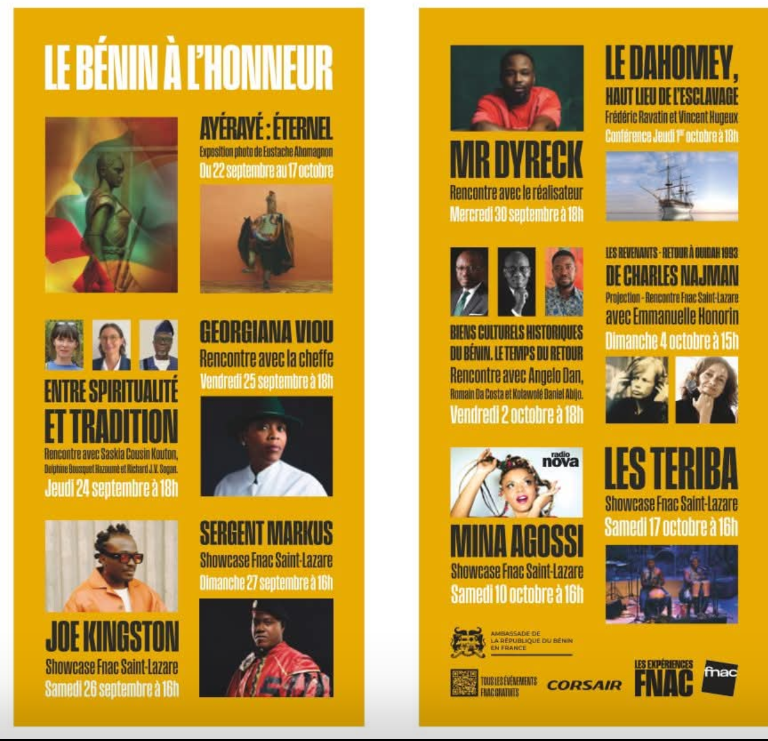
As Benin’s month-long cultural showcase at Fnac Saint-Lazare in Paris draws to a close, reactions are pouring in—from enthusiastic praise to critical questions about memory, restitution, and representation. Running from September 22 to October 17, 2026, the program has ignited public discourse far beyond its exhibition walls, prompting audiences to ask not just what was shown, but what comes next for Franco-Beninese cultural relations.
Public response and the weight of history
The residency—backed by the Embassy of the Republic of Benin in France—was never intended as mere celebration. Instead, it wove together photography, literature, music, film, and scholarly dialogue to confront complex legacies: the Kingdom of Dahomey, the transatlantic slave trade, Vodun spirituality, and the ongoing restitution of looted artifacts. This layered approach resonated deeply with many visitors, especially members of the Beninese diaspora, who saw their heritage reflected with nuance rather than nostalgia.
Yet the programming also stirred debate. Some critics questioned whether a commercial venue like Fnac could adequately host such sensitive historical conversations. Others welcomed the boldness, arguing that placing these dialogues in a mainstream Parisian space democratized access to African narratives long excluded from France’s cultural mainstream.
Artists lead the conversation forward
From day one, contemporary voices set the tone. Eustache Ahomagnon’s photo-textile exhibition “Ayérayé: Éternel” opened the residency by merging ancestral Egungun traditions with modern visual language—a metaphor for the entire event. Later, chef Georgiana Viou linked culinary artistry to cultural resilience, while musicians like Joe Kingston and Sergent Markus fused hip-hop, slam poetry, and Vodun rhythms into new sonic identities.
These performances weren’t just entertainment; they served as counter-narratives. By centering living creators—not just historical relics—the program challenged static perceptions of Benin as a museum piece, instead presenting it as a dynamic, evolving cultural force.
Restitution and memory take center stage
The most charged discussions emerged during sessions on colonial legacy. On October 2, Ambassador Angelo Dan joined heritage curator Kolawodé Daniel Abidjo and cultural strategist Romain Da Costa to dissect the landmark restitution process between France and Benin. The conversation went beyond legalities, probing how returned artifacts might reshape national identity and museum ethics.
Equally powerful was the October 1 dialogue on the Dahomey Kingdom and slavery, featuring journalist Vincent Hugeux and scenographer Frédéric Ravatin. Their discussion around the “Boat of Memory” in Ouidah underscored how public memorials can transform trauma into collective reckoning—a theme echoed in Charles Najman’s documentary “Return to Ouidah 1993,” screened on October 4.
What remains after the lights dim?
With all events free and open to the public, Fnac Saint-Lazare attracted diverse crowds—students, scholars, diaspora families, curious Parisians. But the real test lies ahead: will this residency catalyze lasting change? Advocates hope it seeds future collaborations, deeper institutional partnerships, and sustained investment in Beninese artists abroad.
Already, emerging figures like filmmaker Mr DYRECK and jazz vocalist Mina Agossi have signaled a new generation’s confidence in telling West African stories on global stages. And with Teriba—the pioneering all-female Beninese ensemble—closing the program on October 17, the message was clear: Benin’s culture is not only remembered—it is actively being remade.
A turning point or a temporary spotlight?
The true legacy of this residency may hinge on what follows. If it inspires more French institutions to share platforms with African nations on equal terms—and if restitution evolves from symbolic gestures to systemic reform—then Fnac Saint-Lazare’s four-week experiment could mark a genuine shift. For now, Paris has had a taste of Benin’s depth. The question echoing through forums and social feeds alike is simple: what will the city do with it?