In Burkina Faso, the struggle for journalistic independence has expanded beyond traditional newsrooms and physical reporting, now encompassing a digital front where coordinated harassment campaigns are waged across social media platforms.
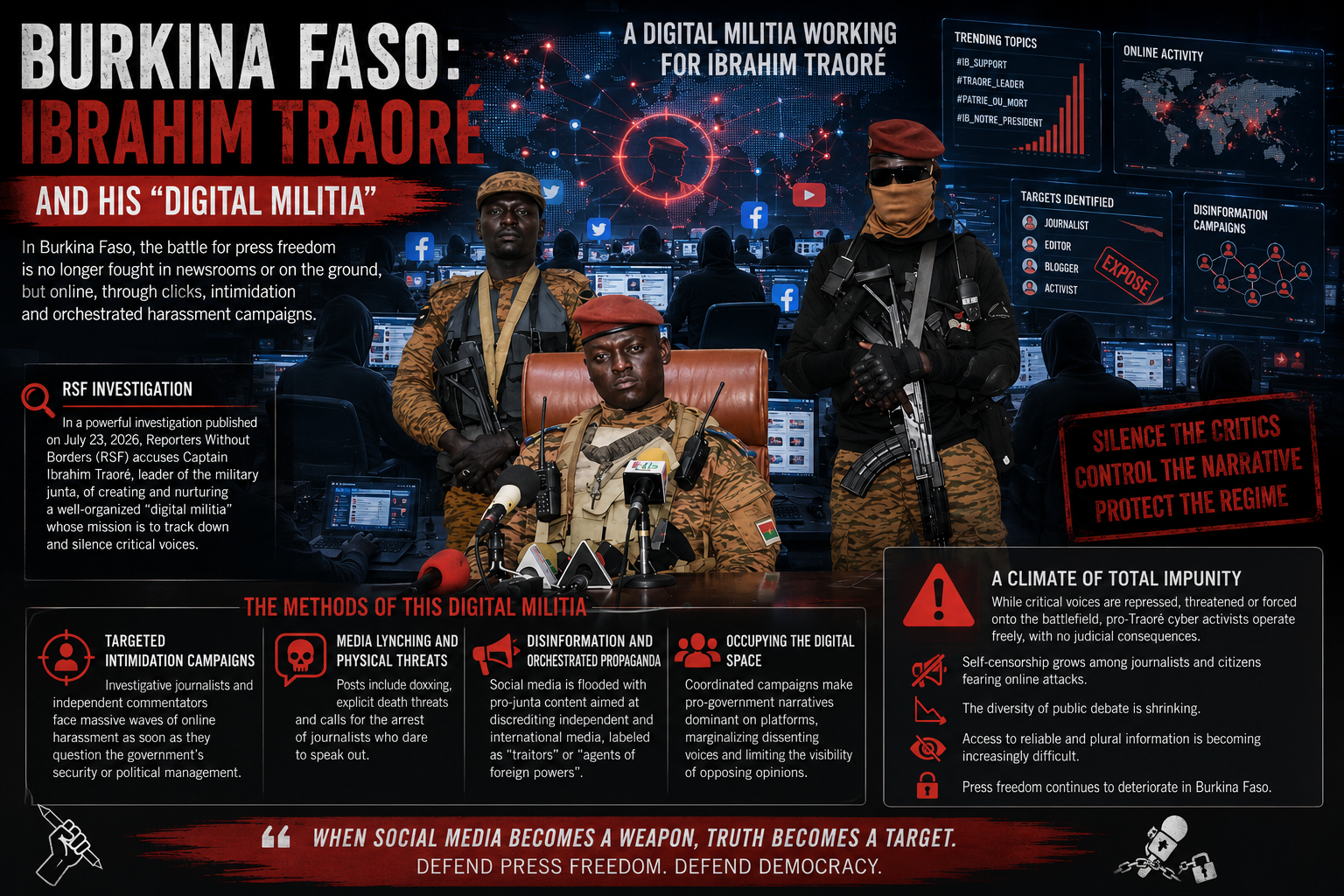
A recent comprehensive inquiry by Reporters Without Borders (RSF) explicitly implicates Captain Ibrahim Traoré, the leader of the military junta. RSF alleges that Traoré has cultivated and maintained an active «digital militia» specifically designed to monitor and suppress critical discourse against the regime.
The BIR-C: virtual battalions tracking dissidents
Central to this intimidation strategy is a meticulously organized network of cyber-activists, operating under the designation of Communication Rapid Intervention Battalions, or BIR-C. This nomenclature intentionally mirrors conventional military units, yet their operational sphere is entirely digital.
These covert operatives, as detailed in the RSF report, function with synchronized precision to dominate the virtual public sphere, effectively stifling any opposing viewpoints. RSF concludes that this phenomenon transcends mere political activism found on social media; rather, it represents a calculated strategy not only to champion government decisions but also to impose significant repercussions on any individual who dares to voice criticism of the regime.
The BIR-C’s operational methods:
- Systematic intimidation campaigns are directed at specific individuals: Investigative journalists and independent columnists are subjected to extensive waves of cyberharassment whenever they scrutinize the government’s security or political management.
- Calls for media lynching and physical threats: The communications from these networks extend beyond political critique, frequently involving the dissemination of personal data (doxxing), explicit death threats, or calls for the arrest of unyielding journalists.
- Orchestrated disinformation and propaganda: Social media platforms are saturated with pro-junta content streams designed to discredit traditional local and international media outlets, often pejoratively labeled as «traitors» or «proxies for foreign powers.»
- Digital space occupation: Coordinated campaigns also ensure that narratives favorable to the authorities achieve widespread dominance on certain platforms, thereby marginalizing contradictory analyses and severely limiting the visibility of divergent opinions.
A climate of complete impunity
A significant concern highlighted is the complete absence of judicial response to these actions. While critical voices face swift repression or even forced conscription into military service, pro-Traoré cyber-activists operate with impunity, effectively enjoying state protection.
This environment, as noted by numerous observers, fosters a pervasive climate of self-censorship. Confronted with the threat of harassment campaigns, many journalists, bloggers, and online users now opt to avoid sensitive topics, particularly those concerning security, governance, or military operations. This psychological pressure functions as an indirect yet potent restriction on freedom of expression, negating the need for formal prohibitions.
A strategy that undermines democratic debate
Experts in political communication emphasize that when digital platforms are saturated with coordinated campaigns, public discourse progressively loses its inherent diversity. Dissenting opinions become less discernible, while narratives supportive of the authorities increasingly dominate online conversations.
Amidst an ongoing security crisis, this polarization further complicates citizens’ access to diverse information sources. Yet, a plurality of information remains crucial for the public to comprehend national challenges and critically assess public policies.
The tactics detailed by RSF bear resemblance to documented practices in various authoritarian or hybrid regimes, where coordinated cyber-activist networks are deployed to bolster the government, discredit independent media, and manipulate online discourse. International organizations advocating for press freedom now regard these campaigns as a novel form of pressure—less conspicuous than traditional censorship, yet frequently just as effective in suppressing critical voices.
Pressure augmenting existing restrictions
This digital dimension is not an isolated phenomenon but rather an integral part of an environment already constrained by media restrictions. In recent years, several international media outlets have faced suspension or outright bans from broadcasting within Burkina Faso, while journalists have reported instances of intimidation, summonses, and temporary disappearances.
For proponents of press freedom, the convergence of administrative actions, security pressures, and online harassment campaigns progressively diminishes the scope for independent expression.
An alarming authoritarian drift for observers
This comprehensive inquiry solidifies observations regarding the continuous erosion of democratic space and freedom of information in Burkina Faso since the junta’s ascension to power. By employing digital encirclement tactics, the Traoré regime transforms social media into an instrument of political coercion, rendering independent journalism increasingly hazardous within the nation.
The organization’s findings are also poised to intensify concerns among international partners regarding the state of free expression in Burkina Faso. Press freedom indicators are routinely factored into assessments by investors, international organizations, and development partners to gauge a country’s governance quality and institutional environment. A sustained decline in these metrics could significantly impair Burkina Faso’s international standing.
Ultimately, this investigation illuminates a broader evolution in information warfare. While propaganda historically relied primarily on state-controlled media, social networks have emerged as a strategic battleground where content dissemination speed, algorithms, and virality enable the amplification of specific narratives while marginalizing opposing viewpoints. Many analysts contend that this development now constitutes one of the foremost challenges for safeguarding press freedom and democratic discourse in states grappling with significant political and security instability.