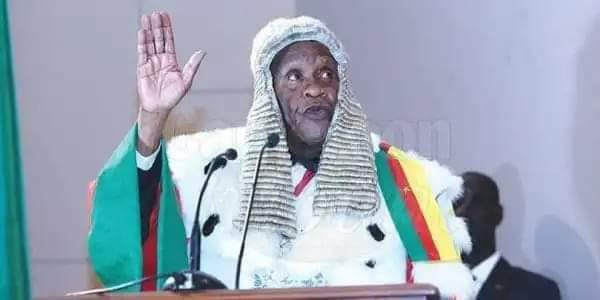
The sudden passing of Clément Atangana, Cameroon’s longest-serving president of the constitutional council, marks a watershed moment for the nation’s electoral oversight body. His death in Paris on October 4, 2026, after a prolonged illness, leaves a void at the helm of a high-stakes institution that has shaped Cameroon’s political landscape for nearly a decade.
The voice of the constitutional council: Atangana’s 8-year legacy
Atangana, born on December 20, 1941, in Ekoumeyeck, carried a voice that became synonymous with judicial authority in Cameroon. His tenure as the council’s president, which began in February 2018, was defined by a decisive approach to electoral disputes. The word « irrecevable »—often delivered with finality—echoed through courtrooms and political circles alike, shaping public perception of the council’s role in arbitrating high-stakes elections.
Under his leadership, the council ruled on contentious cases stemming from two presidential elections: 2018 and 2025. In both instances, the opposition contested the official results, first by Maurice Kamto of the MRC and later by Issa Tchiroma Bakary. Despite widespread skepticism about the council’s independence, Atangana’s rulings consistently favored the status quo, reinforcing perceptions of institutional alignment with the ruling establishment.
A career of firsts: From Nkongsamba to the constitutional summit
Atangana’s ascent in Cameroon’s judiciary was nothing short of meteoric. Trained at the National School of Administration and International Institute of Public Administration in Paris, he joined the magistracy in 1968. His career spanned over four decades, with key roles including judge in Nkongsamba, president of tribunals in Eséka, Bafia, and Sangmélima, prosecutor general in Maroua, and president of the Court of Appeal of the Center. He also served as a supreme court justice and president of the Administrative Chamber before retiring in 2014—only to be recalled four years later to lead the constitutional council.
What’s next? The constitutional council’s uncertain future
The passing of Atangana triggers a constitutional crisis, leaving the highest electoral oversight body in Cameroon without leadership. His eight-year tenure, marked by controversial rulings and persistent allegations of institutional bias, now faces an uncharted chapter. President Paul Biya holds the constitutional mandate to appoint a successor, a decision that will reverberate across the political spectrum and test the council’s credibility in the eyes of an increasingly skeptical public.
- The stakes: The new president will inherit an institution under scrutiny, tasked with overseeing future elections amid growing demands for transparency and fairness.
- The challenges: Rebuilding public trust may prove difficult, given the council’s history of rejecting opposition-led challenges to electoral outcomes.
- The legacy: Atangana’s departure signals the end of an era, leaving behind a complex judicial legacy that will shape Cameroon’s democratic discourse for years to come.
From magistrate to icon: A life in service to Cameroon
Beyond his judicial duties, Atangana’s career reflected a commitment to public service during a transformative period for Cameroon. His rise from a judge in Nkongsamba to the presidency of the constitutional council underscored his influence within the country’s legal and political spheres. While his rulings often sparked debate, there was no denying his impact—a legacy that will now be scrutinized in his absence.
Key moments in Atangana’s judicial journey
- 1968: Begins career as a magistrate after training at ENAM and the International Institute of Public Administration in Paris.
- 1980s–2000s: Holds pivotal roles including prosecutor general, president of the Court of Appeal of the Center, and justice of the Supreme Court.
- 2014: Retires from the Supreme Court but is recalled four years later to lead the constitutional council.
- 2018: Appointed president of the constitutional council ahead of the presidential election.
- 2018–2025: Oversees electoral disputes, including the contested 2018 and 2025 presidential elections.