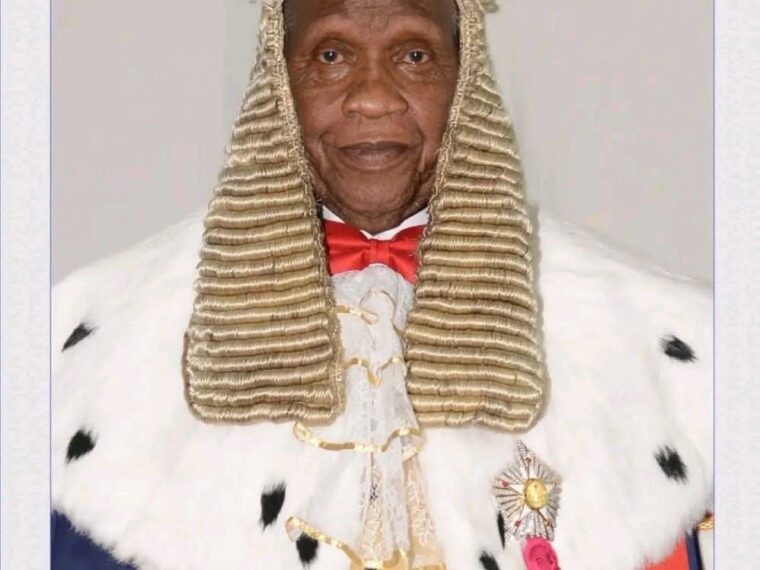
The death of Clément Atangana in Paris this morning represents a decisive turning point for Cameroon’s Constitutional Council. The 85-year-old president of the institution had been evacuated to France for advanced medical treatment, but fate intervened, and he passed away before receiving the care he sought. His demise signals a major shift in the country’s constitutional landscape, closing a controversial chapter and opening a new era of uncertainty.
A tenure defined by controversy
Atangana, a native of Ngomedzap in the Nyong and So’o division, was a magistrate of the highest rank. However, his tenure as head of the Constitutional Council was marred by accusations of partiality. During the 2018 presidential election disputes, the Council under his leadership rejected all petitions with the now-infamous verdict of “irrecevable” (inadmissible). This led the public to nickname him “Irrecevable.” Since then, the Constitutional Council has been widely viewed as an institution subservient to the ruling party, the RDPC.
Atangana often fueled these perceptions. On the night the presidential election results were announced, a video surfaced on social media showing him celebrating with his family, claiming that Paul Biya, the incumbent, had won. He referred to Biya as “your candidate” when addressing his relatives, further cementing suspicions of bias.
Allegations of partisanship
In 2025, Atangana participated in a meeting of the Nyong and So’o Development Committee, which resulted in a motion of support for Paul Biya and a call for him to run in the next presidential election. A reporter from Cameroon Tribune, the government-owned newspaper, covered the event, sparking widespread media debate and criticism. Atangana attempted to clear his name, stating that he had attended a meeting of an apolitical association and had not taken part in the session that produced the motion. Nevertheless, the image of him as a Biya supporter was already entrenched in the minds of many opponents. He had also been filmed in a jubilant mood after his appointment, further reinforcing this perception.
What lies ahead
With Atangana’s passing, Cameroon’s Constitutional Council faces a pivotal moment. The institution must now navigate a transition that will be closely watched, given its critical role in electoral justice. The coming days will reveal how this turning point shapes the Council’s future and its credibility in the eyes of the public.