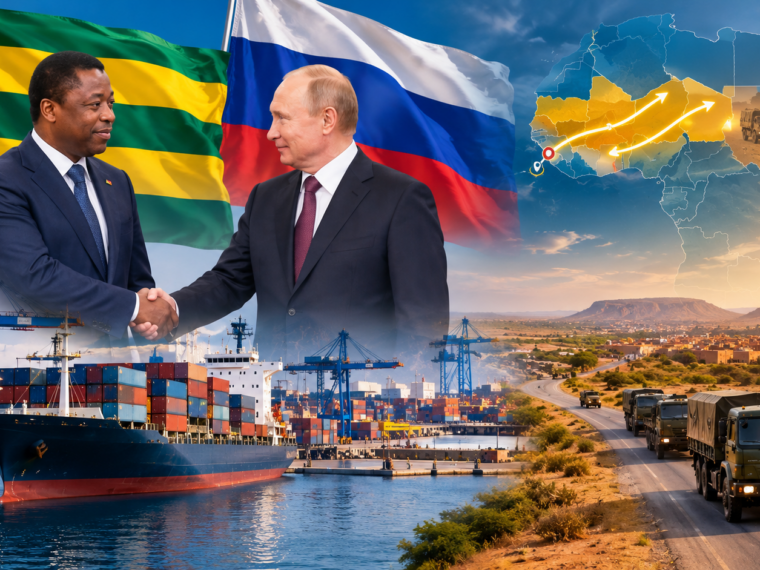
The evolving partnership between Lomé and Moscow has taken a decisive turn, with Togo’s capital now positioned at the heart of a transformative initiative that could redefine commercial and logistical dynamics across West Africa and the Sahel. At the crux of this development is a proposed transport corridor designed to streamline the movement of Russian goods into Togo and multiple Sahelian markets a move that signals a broader recalibration of regional trade routes.
Russian Deputy Minister of Transport Alexei Chilo unveiled this initiative during the inaugural session of the Russo-Togolese Intergovernmental Commission in Lomé, held from September 29 to October 1, 2026. A 29-member Russian delegation engaged with Togolese officials and industry leaders to discuss cargo transportation, cost optimization, infrastructure enhancements, and avenues for deepening bilateral exchanges.
The delegation toured key Togolese infrastructure, including the Autonomous Port of Lomé, Gnassingbé Eyadéma International Airport, and the Adétikopé Industrial Platform, underscoring the strategic scope of the discussions.
Lomé as a gateway to the Sahel: a response to shifting regional dynamics
The timing of this initiative is no coincidence. Recent disruptions in traditional trade routes particularly the prolonged closure of the Benin-Niger border have intensified competition among regional ports, creating both challenges and opportunities. In this fluid landscape, the Port of Lomé emerges as a compelling alternative for supplying Sahelian markets.
Yet what distinguishes this case is not merely Lomé’s potential as a commercial hub. The port has already facilitated the transit of Russian matériel destined for the Sahel, as demonstrated by the controversial arrival of the Mikhail Britnev earlier this year.
From commercial transit to strategic logistics: the Mikhail Britnev precedent
On July 9, 2026, the Mikhail Britnev, a Russian cargo vessel sanctioned by the United States since 2024, docked in Lomé. Maritime tracking data confirmed its arrival, followed shortly thereafter by the appearance of a military convoy in Bamako. Satellite imagery and expert analysis suggested the vessel had transported trucks, armored personnel carriers, and other military vehicles that later traversed Togo and Burkina Faso en route to Mali.
Critical Threats estimates that approximately 50 military vehicles were delivered to the Africa Corps in Mali, marking one of the first documented instances of Lomé serving as a logistical entry point for Russian matériel into the Sahel. While this does not imply the new corridor will exclusively serve military purposes, it demonstrates Lomé’s capacity to link Russian maritime routes with terrestrial networks heading inland.
Beyond trade: the strategic ambitions behind the corridor
The Russia-Togo partnership extends beyond mere commercial transactions. Moscow’s objectives now include securing logistical corridors, energy partnerships, transport infrastructure, and access to Sahelian markets. The Mikhail Britnev case illustrates this evolving logic: a Russian ship arrives in Lomé, offloads its cargo, and the contents are transported overland to Mali via Togo and Burkina Faso.
The newly announced corridor could institutionalize this approach, transforming Lomé from a transit point into a regional hub. The critical question remains: Is Russia merely expanding economic ties with Togo, or is it positioning the port as a gateway to the Sahel?
A relationship forged in Moscow and reinforced in Lomé
The foundations of this collaboration were laid during a November 2025 meeting in Moscow, where Togolese President Faure Gnassingbé and Russian President Vladimir Putin discussed economic, energy, and security cooperation, with a focus on Sahelian stability. Since then, the partnership has evolved from diplomatic dialogue to concrete infrastructure projects transport, energy, industry, and logistics.
This trajectory culminated in the 2026 commission meetings, where discussions shifted from policy to practical implementation. The presence of Russian personnel in Togo further underscores the depth of the alliance.
Togo’s pivotal position in Russia’s West African strategy
Faure Gnassingbé’s alignment with Moscow raises geopolitical questions: How far will Togo go in deepening its ties with Russia? If Lomé becomes a primary entry point for Russian goods destined for the Sahel, Togo could ascend as a key player in Moscow’s economic and logistical strategy for West Africa.
Yet the military dimension cannot be overlooked. The Mikhail Britnev case provides a concrete example of how civilian infrastructure can facilitate strategic movements. While not all future cargo will be military in nature, the precedent highlights Lomé’s potential as a dual-use logistics node.
The Adétikopé Industrial Platform: a game-changer
The Russian delegation’s visit to the Adétikopé Industrial Platform home to significant logistical and manufacturing facilities hints at a broader vision. Lomé could evolve from a mere transit hub into a center for storage, processing, investment, and regional redistribution, altering the project’s fundamental nature.
A port facilitates the movement of goods; a true logistics hub enables reception, storage, transport, and even transformation before redistribution. This expanded role could redefine Togo’s significance within Russia’s African strategy.
A new frontier in West African corridor competition
The stakes extend beyond which port will handle Russian shipments. The competition revolves around which nations will control the primary trade routes linking Russia to Sahelian markets and which powers will manage the logistics. Lomé’s advantages its coastal access, robust port infrastructure, inland connectivity, and the Adétikopé platform make it a prime candidate.
Russia appears determined to leverage these assets. The Mikhail Britnev case proves this possibility is no longer theoretical.
Lomé’s future: a hub of multiple interests
As traditional corridors realign and Sahelian nations seek new supply routes, Togo’s strategic location places it at the nexus of Russian commercial interests, Gulf of Guinea logistics, and Sahelian demand. The question is no longer confined to bilateral trade but extends to the architecture of an emerging economic, logistical, and security framework centered on Lomé.
While a definitive timeline for the corridor’s full implementation remains unannounced, one development is clear: the Togo-Russia relationship is transitioning from diplomatic engagement to operational cooperation. In a Sahel where alliances are in flux, the Port of Lomé could emerge as one of the continent’s most critical nodes of transformation.
By Thomas Nkoulou — Journalist