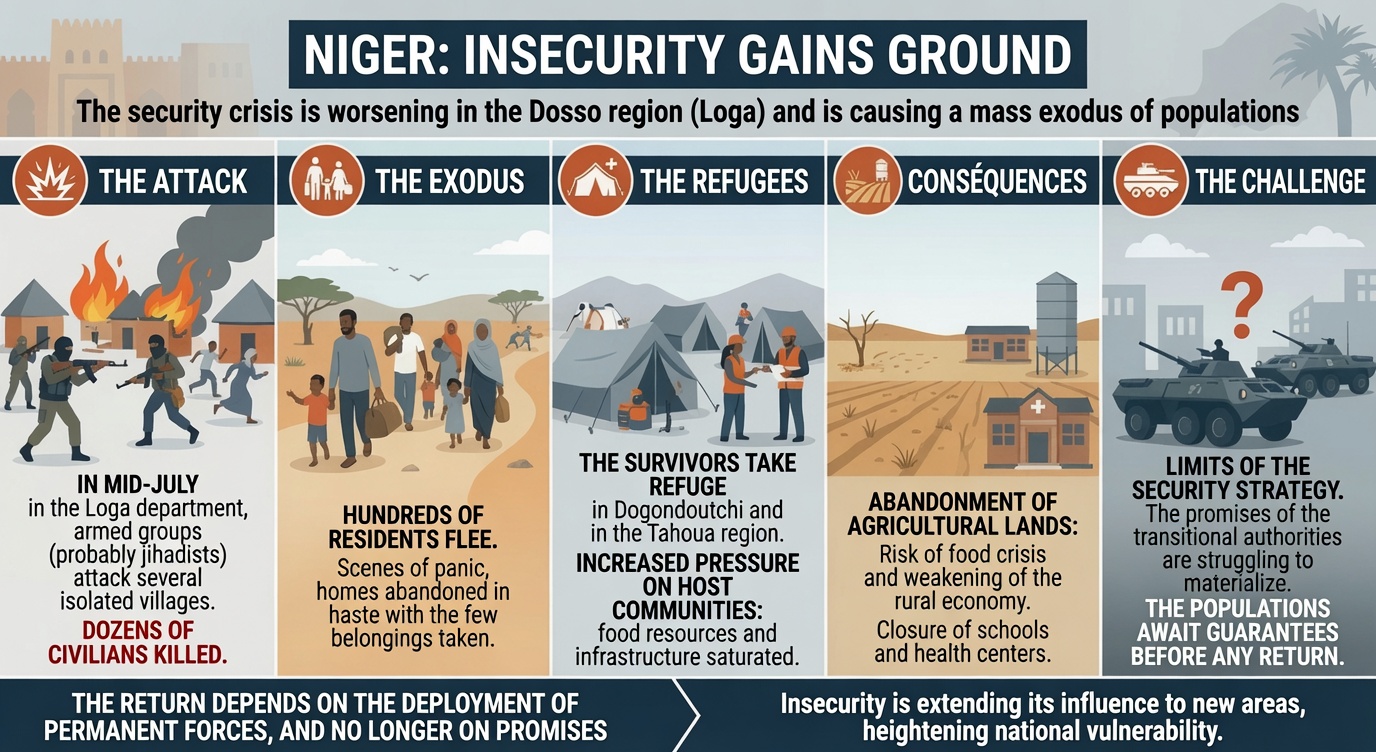
Niger is grappling with a deepening security crisis, as evidenced by the latest wave of violence in the Loga department of the Dosso region. In mid-July, coordinated attacks attributed to armed jihadist groups forced hundreds of residents to flee their villages, leaving behind homes, livelihoods and a fragile sense of stability. The assaults, marked by their brutality, underscore a troubling pattern: despite repeated assurances from military authorities, many communities remain vulnerable to incursions, with civilians bearing the brunt of the conflict.
Devastating attacks spark mass exodus
Local accounts describe how attackers targeted remote villages, exploiting gaps in security measures to inflict heavy losses on unprotected populations. Survivors recount harrowing scenes of panic, abandoned homes and families fleeing with only the barest essentials. The death toll among civilians has risen significantly, with dozens confirmed dead in the initial wave of violence.
In the aftermath, displaced residents have sought refuge in Dogondoutchi and surrounding areas in the Tahoua region, hoping to find greater safety. Yet their arrival has placed additional strain on host communities already struggling with economic hardship, inadequate infrastructure and limited access to food supplies. The sudden influx has overwhelmed local resources, leaving many displaced families in precarious conditions.
Security strategy under scrutiny
The latest surge in violence has reignited doubts about the effectiveness of Niger’s transitional government’s security strategy. Since the change in leadership, restoring national security has been touted as the junta’s top priority. However, attacks continue to strike both border regions and inland areas, raising serious questions about the durability of military operations and the redeployment of defense forces. The persistence of such violence suggests deeper systemic challenges in countering insurgent movements.
The growing number of internally displaced persons (IDPs) serves as a stark indicator of the conflict’s escalation. When communities abandon their homes, farmlands and sources of income, it signals a profound erosion of trust in the state’s ability to protect them. For many, returning is no longer just about the end of hostilities—it hinges on tangible security guarantees and a sustained military presence.
Humanitarian crisis deepens amid economic strain
The humanitarian fallout from the displacement is severe. Abandoned farmlands threaten upcoming harvests, exacerbating food insecurity and destabilizing rural economies already weakened by years of conflict. Schools are closing, health centers are operating at reduced capacity, and local markets are struggling to function, leaving communities increasingly vulnerable.
Humanitarian organizations warn of a mounting crisis as the number of displaced persons continues to rise. Access to food, clean water, medical care and dignified shelter remains critically insufficient. Aid agencies are stretched thin, with resources failing to keep pace with the growing needs of those uprooted by violence.
Communities await concrete action
While authorities have pledged to strengthen military presence in affected zones to facilitate returns, skepticism remains widespread among locals. Many insist they will not return until security forces are permanently deployed and capable of preventing future attacks. Promises alone, they argue, are no longer enough in the face of recurring violence.
The crisis in Loga is not an isolated incident but part of a broader trend. The spread of attacks into new regions has intensified concerns about the expanding reach of armed groups and the vulnerabilities within Niger’s security apparatus. For residents, the immediate priority is survival—until safety is assured, the exodus will likely continue, with consequences that extend far beyond the immediate area of conflict.