Emergency fuel delivery redirects to Niger’s capital
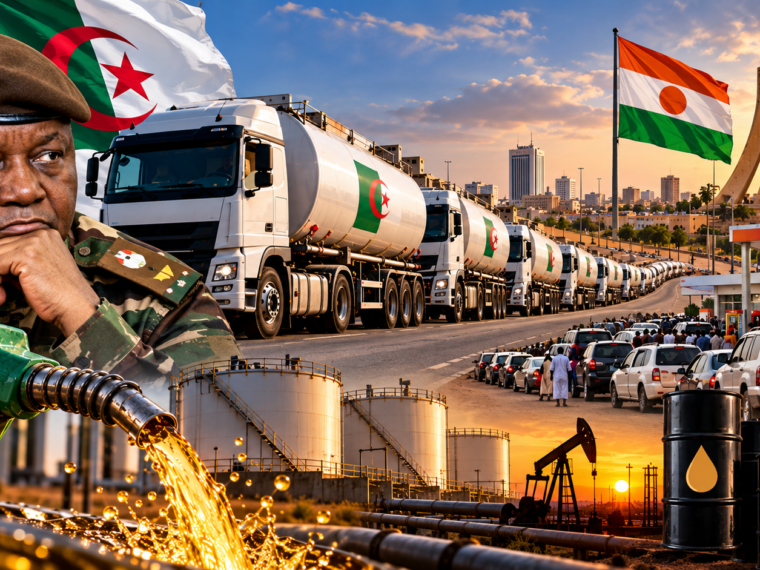
What was initially designed as an emergency supply operation for Agadez has been rerouted to Niamey, bringing 3.75 million liters of Algerian-sourced fuel to the Nigerien capital. The move raises questions about logistical priorities and financial implications for the landlocked nation.
Cost comparison highlights economic impact
The Algerian fuel arrives at a price point of 800 FCFA per liter, significantly higher than the previous 702 FCFA cost from Nigerian suppliers. While the agreement specifies settlement in crude oil rather than cash, the price differential remains substantial. For the full volume, this represents an additional cost of 367.5 million FCFA compared to the previous supply chain. However, price alone does not determine operational necessity.
Contract terms and valuation remain unclear
Critical details about the crude oil repayment mechanism remain undisclosed, including the exact volume to be exchanged and its valuation method. Without full transparency on these terms, the true economic burden of this emergency procurement cannot be accurately assessed. Authorities have not provided clarification on whether the transaction represents a strategic decision or merely a reactive measure.
Strategic reserves: a question of national security
Beyond immediate cost concerns, this delivery presents an opportunity to bolster Niamey’s fuel reserves. The capital’s daily operations from public transport to emergency services depend on uninterrupted fuel supply. Yet without knowing the exact distribution breakdown between immediate consumption and reserve accumulation, it remains unclear how long these 3.75 million liters will sustain the city.
Experts emphasize that crisis response alone cannot replace systematic reserve building. A sustainable fuel security strategy requires:
Clear quantification of daily consumption rates
Designated storage capacity and management protocols
Mechanisms to prevent stockpile deterioration or diversion
Diversified supply channels to reduce single-route dependency
Agadez’s unmet needs spark further debate
The redirection of fuel deliveries raises immediate concerns for Agadez, which was set to benefit from this consignment. Authorities have not explained how the northern city’s fuel requirements will now be met, nor whether this shift reflects a temporary adjustment or a fundamental change in distribution priorities. The lack of official communication on these decisions continues to fuel speculation.
Balancing urgency with long-term planning
While emergency imports address immediate shortages, they risk masking deeper structural issues in Niger’s fuel supply chain. Diversification of supply routes holds strategic value, but only if acquisition costs and reliability are systematically evaluated. The current arrangement regardless of its short-term benefits highlights the urgent need for:
Transparent reporting on fuel procurement mechanisms
Calculation of total economic costs (including crude oil valuation)
Development of formal reserve policies
Clear contingency plans for future supply disruptions
The arrival of Algerian fuel in Niamey serves as both a lifeline and a cautionary tale. Without proactive planning, even well-intentioned emergency measures may prove inadequate when the next supply crisis emerges.
By Agnès Mvogo — Journalist