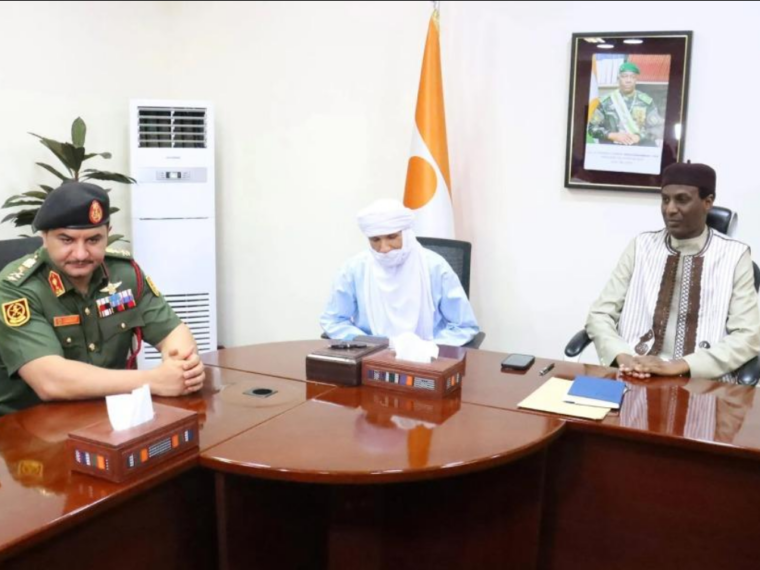
In a rapid sequence of diplomatic and military moves, the Sahel is experiencing a strategic reshuffle where the Niger finds itself at the center of shifting power dynamics. Within days, high-level engagements between Niamey, Benghazi, Paris, and Algiers have redefined regional alliances, raising questions about the country’s evolving role in the broader geopolitical landscape.
Libya and Niger seal strategic partnership as Haftar strengthens ties with Niamey
On November 1, 2026, Nigerien Prime Minister Ali Mahaman Lamine Zeine traveled to Benghazi for talks with Libyan Vice-Commander Saddam Haftar. The meeting culminated in the signing of a strategic cooperation protocol, signaling Niamey’s intent to expand its security and political partnerships in North Africa. While specifics of the agreement remain undisclosed, the initiative underscores a deliberate effort to diversify alliances beyond traditional partners.
Two days later, Libyan Eastern Forces Chief of Staff Khaled Haftar arrived in Paris for discussions with French military leadership. Reports indicated the talks focused on military cooperation, security coordination, training, and expertise sharing. The timing of these engagements—Niamey-Benghazi and Haftar-Paris—hints at a broader realignment of interests in the Sahel.
Algeria doubles down on regional influence amid rising competition
As Libya and France deepen their engagements with Niger, Algeria has intensified its diplomatic push in the Sahel. On November 3, Algerian Foreign Minister Ahmed Attaf met with Chadian President Mahamat Idriss Déby Itno in N’Djamena, delivering a message from Algerian President Abdelmadjid Tebboune. The visit emphasized bilateral relations, cross-border security challenges, and the implementation of 27 previously signed agreements.
Alger’s proactive stance comes amid strained Niger-Chad relations, with Niamey accusing N’Djamena—without public evidence—of involvement in destabilization efforts with alleged French backing. Chad and France have since moved to restore military and diplomatic ties following the collapse of a 2024 defense pact. For Algeria, strengthening ties with Chad is not just about bilateral cooperation but securing its influence over Sahelian security dynamics.
UAE’s growing role in Libya raises Algerian concerns
The United Arab Emirates has long maintained close political and military ties with Libya’s Eastern camp, led by Khalifa Haftar. While Abu Dhabi’s current engagement levels are not fully clear, its historical support for Haftar’s forces adds a layer of complexity to regional rivalries. Algeria views Libya’s stability as vital to its national security and is wary of any foreign military presence near its southern borders.
The Haftar camp’s advance into southern Libya—particularly in the Fezzan and transit corridors linking Libya to Niger—has heightened Algerian concerns. These areas are critical for migration flows, trade, energy routes, and illicit networks. The Niamey-Benghazi rapprochement could be seen as either a mutual security effort or a strategic move by Haftar to extend influence southward. For Algeria, which is also vying for influence in Niger, this development demands closer scrutiny.
Morocco-Algeria rivalry fuels Sahel competition
The long-standing rivalry between Algeria and Morocco has expanded beyond the Maghreb into the Sahel. Since diplomatic relations ruptured in 2021, the two countries have pursued opposing strategies, including divergent approaches to the Western Sahara issue. This divide has spilled into African partnerships, with Morocco cultivating ties in the Sahel while Algeria seeks to preserve its historical role.
The October 11-15, 2026 visit by Khaled Haftar to Morocco—where he met with General Mohammed Berrid, Inspector General of the Royal Armed Forces—has not gone unnoticed in Algiers. The convergence of Rabat, Abu Dhabi, and Haftar’s camp has fueled Algerian suspicions of emerging regional alignments, even if no formal alliance has materialized.
Niger’s strategic value in a shifting Sahel
Amid these developments, Niger has emerged as a highly sought-after partner due to its geographic position, energy resources, and proximity to Libya, Algeria, Chad, and Mali. On October 25, 2026, Algeria’s Parliament approved the deployment of military forces in Niger, marking a significant shift in Algiers’ security posture. Combined with the Niamey-Benghazi agreement and Algeria’s diplomatic outreach, Niger is actively diversifying its alliances to avoid over-reliance on a single partner.
France, whose military footprint in the Sahel has significantly diminished, continues to engage with regional actors. The Paris meeting with Haftar reflects Paris’ efforts to maintain security partnerships, though it does not necessarily indicate a coordinated strategy centered on Niger.
The recent flurry of activity reveals a broader truth: the Sahel is no longer just a battleground against armed groups. It has become a competitive arena for control over trade routes, energy resources, and geopolitical influence. In this new struggle, Niger is not merely a country facing security threats—it is a linchpin in the reshaping of Sahel-Sahara geopolitics.