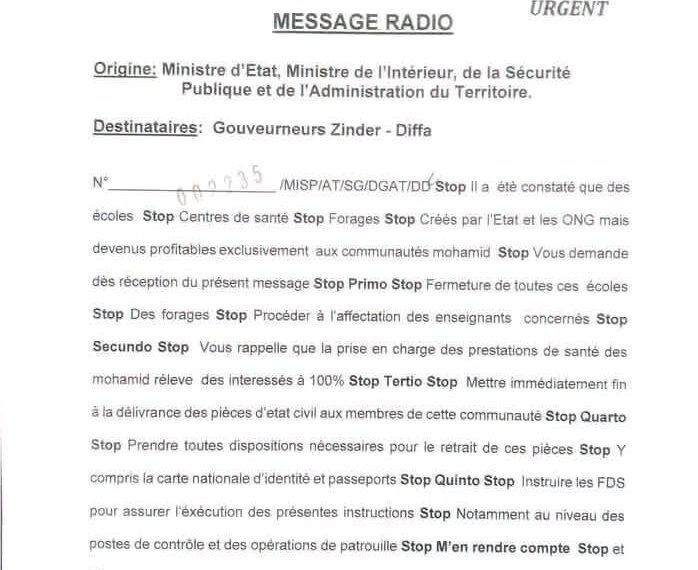
An urgent radio directive issued by Niger’s Interior Ministry has triggered immediate action against the Mohamid ethnic group, raising alarm over the suspension of fundamental rights. Dated October 7, 2026, the order to regional authorities in Zinder and Diffa demands comprehensive measures: school closures, water source restrictions, discontinued healthcare access, and withdrawal of civil documentation, including national ID cards and passports.
The enforcement of these instructions appears to be underway, pushing the controversy beyond a mere administrative decision. It forces a critical examination: can a state justify depriving an entire community of essential rights under the guise of national security?
What the directive entails
The Interior Ministry’s instructions, attributed to the government of General Abdourahamane Tiani, target education, water supply, healthcare, and civil registration systems. Key actions include:
- Mandatory closure of schools serving the Mohamid population;
- Reassignment of teachers currently assigned to these schools;
- Suspension of collective healthcare support for community members;
- Immediate halt to the issuance of birth certificates, national IDs, and passports to Mohamid individuals;
- Revocations of already issued identification documents;
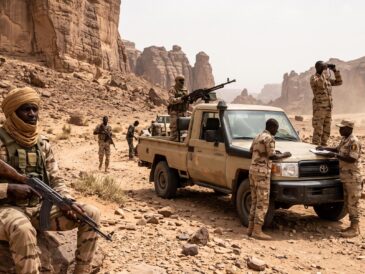
- Deployment of defense and security forces to enforce these measures.
Erosion of basic rights: a dangerous precedent
Access to education, clean water, healthcare, and legal identification documents are not privileges—they are rights that protect human dignity and enable societal participation. By targeting these services specifically at the Mohamid, the government risks undermining the very foundations of fairness and equality.
School closures deprive children of education, water restrictions endanger families and livestock in the arid Sahel, and the withdrawal of healthcare support threatens public health. The most critical concern, however, lies in the revocation of identity documents. National IDs and birth certificates are essential for legal existence, movement, and access to services. Removing them en masse could render individuals unable to prove their citizenship, obtain employment, or access humanitarian aid.
Collective punishment: a violation of legal principles
Niger’s ongoing security crisis, particularly in the Diffa region, demands vigilance. But responding to threats cannot justify penalizing an entire community based on assumptions of collective guilt. The principle of individual criminal responsibility is a cornerstone of justice—one that cannot be overridden by administrative fiat.
If suspected individuals exist, investigations must follow due process, with evidence presented in a court of law. No ethnic or social identity can serve as a substitute for proof. The blanket targeting of the Mohamid without clear, individualized justification raises immediate questions about the legality and morality of these measures.
Under Tiani, a pattern of rights restrictions
Since the July 2023 military takeover led by General Abdourahamane Tiani, Niger has witnessed a pronounced contraction of civil liberties. Reports from independent human rights organizations document a sharp decline in political freedoms, with opposition parties dissolved, civil society groups restricted, and journalists detained without transparency.
In July 2026, one leading organization highlighted a surge in human rights abuses under military rule, including the stripping of nationality from opposition figures abroad—a policy now affecting 25 individuals since 2024. While different in scope, this practice, like the Mohamid directive, reflects a troubling trend: the use of state power to curtail rights without adequate legal safeguards or recourse.The human and economic toll
The consequences of these measures extend far beyond the Mohamid community. The closure of schools disrupts education for hundreds of children. The restriction of water access threatens the livelihoods of pastoralists and agriculture-dependent households. The suspension of healthcare support endangers public health, particularly for vulnerable populations. And the withdrawal of identity documents creates a growing population at risk of statelessness—vulnerable to exploitation, displacement, and systemic exclusion.
The Mohamid community also plays a vital role in local commerce, transportation, and livestock trade. Widespread exclusion policies risk destabilizing regional economies that depend on these networks, further deepening hardship for all residents.
Accountability and the path forward
The Nigerien government must publicly clarify the legal and operational basis for these measures. It must ensure that affected individuals have full access to appeals and judicial review. Any enforcement must stop immediately until proportional, lawful alternatives are established—such as targeted investigations into suspected individuals rather than blanket punishments.
The state is measured not by its ability to impose restrictions, but by its commitment to protect all citizens. No community should pay the price for the actions of a few. If Niger is to uphold the rule of law and maintain national cohesion, it must reject collective punishment and restore equal protection under the law.