The Spanish government has accused the Partido Popular (PP) of adopting an anti-Moroccan stance, escalating a political feud that goes beyond typical opposition rhetoric. Foreign Minister José Manuel Albares has gone so far as to label the center-right party an obstacle to Spain’s foreign policy, particularly regarding its strategic ties with Morocco.
Since 2022, Spain and Morocco have deepened their relationship through enhanced cooperation on migration, trade, security, and now the joint hosting of the 2030 FIFA World Cup with Portugal. In December 2025, both nations reinforced this alliance with fourteen new agreements and a joint declaration to strengthen political dialogue.
As the PP eyes the prime minister’s office, the question looms: how would it handle this critical partnership if it wins power?
the western Sahara dilemma
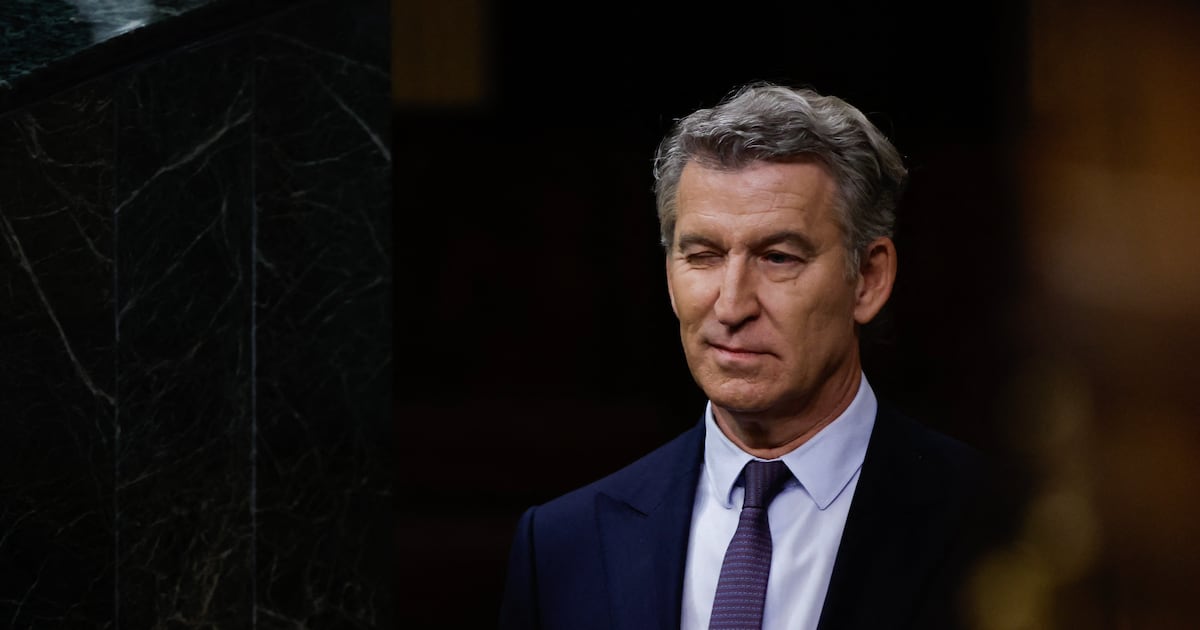
The Western Sahara issue remains the PP’s most glaring contradiction. When Pedro Sánchez’s government endorsed Morocco’s autonomy plan in March 2022 as the “most serious, credible, and realistic basis” for resolving the conflict, the PP condemned the move as a breach of Spain’s long-standing foreign policy consensus. Alberto Núñez Feijóo, the party’s leader, criticized the decision for being made without consulting the opposition.
Yet the PP’s position has never been entirely consistent. Under Mariano Rajoy’s leadership, Spain maintained a cautious approach without outright opposition to Morocco’s proposal. The party has also hosted divergent voices—some advocating for stronger ties with Rabat, others aligning with separatist factions.
The contradictions peaked in July 2025 when a self-proclaimed Polisario representative attended the PP’s national congress, sparking controversy and raising doubts in Morocco about Feijóo’s potential government stance. By February 2026, Foreign Minister Albares accused the PP of sending “emissaries” to Morocco to secretly support the autonomy plan while publicly criticizing it—a claim that, if true, would expose the party’s strategic inconsistency.
a shifting international landscape
The PP would inherit a very different international context if it assumes power. Morocco’s autonomy initiative has gained global traction, and the dispute over Western Sahara has evolved within the United Nations framework. Spain’s position is now embedded in a broader bilateral relationship with Morocco, making any reversal not just a diplomatic tweak but a potential reopening of one of Madrid and Rabat’s most sensitive issues.
The PP has yet to clarify whether a Feijóo-led government would uphold Spain’s current stance or revert to pre-2022 policies. So far, the party has avoided giving a definitive answer.
the rise of ‘national priority’ and its consequences
Beyond Western Sahara, tensions have surfaced over immigration and public benefits. In April 2026, the concept of “national priority”—historically tied to far-right discourse—emerged as a political battleground. Vox, the far-right party, pushed this idea in Congress, forcing the PP to respond to growing public and regional support for the concept.
Some within the PP have expressed concerns over the legal and political fallout of adopting such rhetoric, while others have tried to soften its image by framing it as “residential priority” or “anchoring”. Yet, the debate has already signaled a shift, with Vox successfully influencing the PP’s agenda.
feijóo’s paradox: opposition vs. governance
The PP’s biggest challenge lies in reconciling its opposition rhetoric with the realities of governance. While it can criticize Sánchez’s Morocco policy from the sidelines, governing would require managing a relationship that spans security, economics, and major events like the 2030 World Cup. The most likely outcome isn’t a rupture but a continuation of the current cooperation, leaving the PP to explain to its base why it won’t reverse policies it has long condemned.
The accusation of secret diplomacy with Morocco further underscores this paradox. If true, it suggests the PP may adopt a far more pragmatic approach in private than it does in public.
The real question isn’t whether the PP is anti-Moroccan, as Albares claims, but how far the party is willing to push its rhetoric for electoral gain—and how much of that rhetoric would survive the transition to actual policy. Regardless of who leads Spain, Morocco remains a vital partner, making the PP’s contradictions a critical issue for its potential future government.
If Feijóo reaches the Moncloa Palace, he won’t inherit a blank slate. He’ll step into a deeply transformed bilateral relationship, an internationally recognized position on Western Sahara, a strengthened security partnership, and a shared responsibility to co-host the 2030 World Cup. His first major foreign policy test may well hinge on whether he can bridge the gap between opposition firebrand rhetoric and the pragmatic realities of governing.