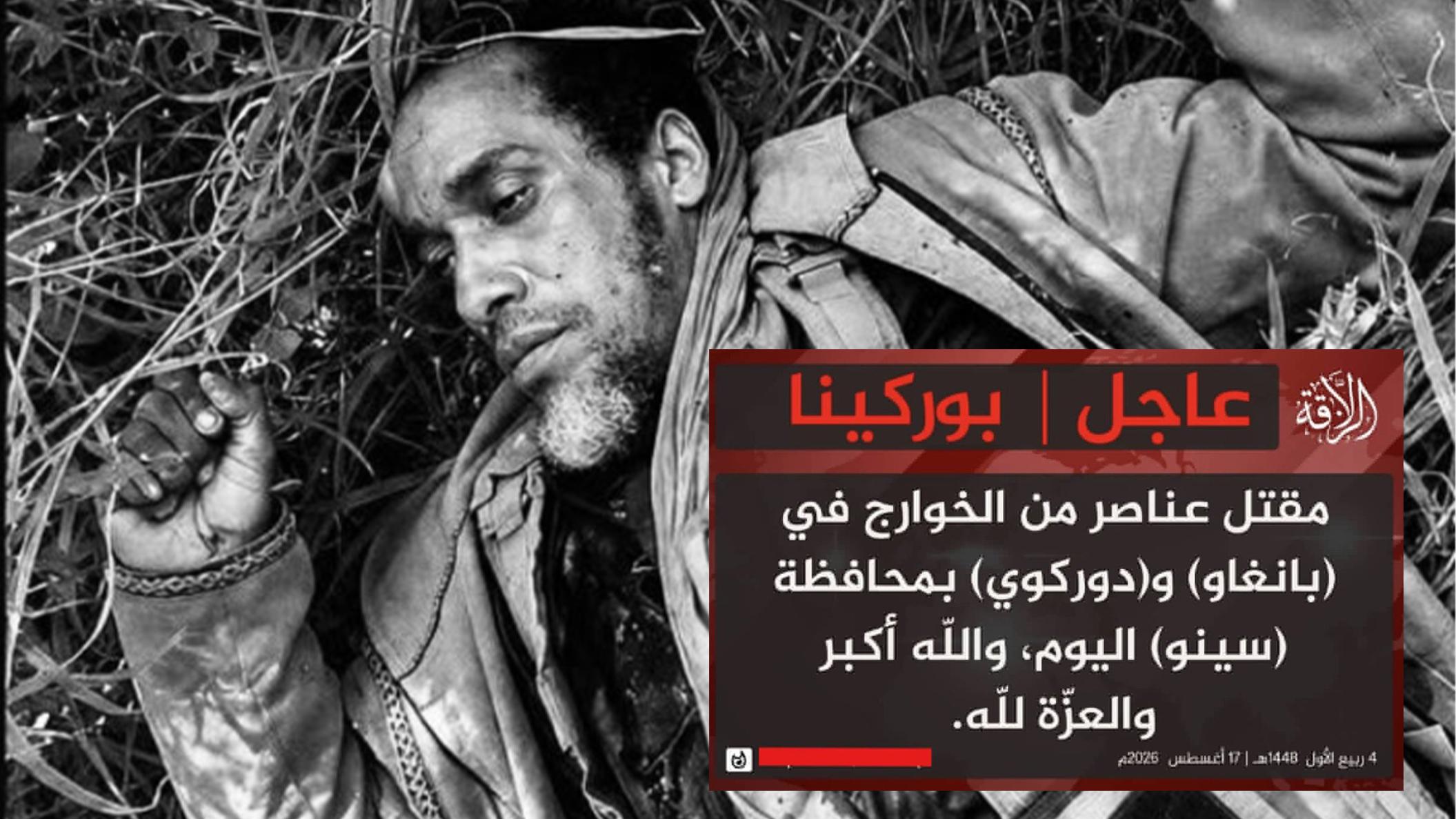
A prominent figure within the Islamic State in the Sahel (EIS), Abou Zeid Al-Burkinabi, met his end on August 17, 2026, in Burkina Faso’s Séno province. Contrary to initial reports from some official channels and media relays, the terrorist leader was not neutralized by the Burkinabè army. Instead, he perished during intense confrontations with the rival Jama’at Nasr al-Islam wal-Muslimin (JNIM) group, a stark illustration of the brutal internecine struggles tearing apart the regional jihadist network.
This event marks a significant setback for the Islamic State in the Sahel (EIS) and further underscores the extreme tensions destabilizing the Sahelian security landscape. According to consistent local and security sources, jihadist commander Abou Zeid Al-Burkinabi was killed this Monday, August 17, in fierce fighting between his loyalists and those of the Al-Qaida-affiliated JNIM.
The clashes unfolded in the localities of Bangao and Dorkoye, situated within the Séno province, in northeastern Burkina Faso. This crucial border region with Niger has been a hotbed of armed insurgency for several years. While early accounts circulating on social media attributed this elimination to a major operation by the Burkinabè armed forces, facts on the ground reveal a different reality: Abou Zeid Al-Burkinabi succumbed to the bullets of his ideological adversaries.
A key figure in the Islamic State in the Sahel
Abou Zeid Al-Burkinabi was far from an ordinary combatant. A native of Burkina Faso, he had steadily risen through the ranks to become one of the EIS’s most vital operational and propaganda cadres in the tri-border area spanning Burkina Faso, Mali, and Niger. His profound understanding of the local terrain, coupled with an extensive recruitment network across Séno and neighboring provinces, made him indispensable for the group’s expansion. As a zone commander, he orchestrated ambushes against defense forces, campaigns of intimidation against civilian populations, and the extortion of local resources through forced zakat collection. His demise represents a severe blow to the EIS’s command structure, already weakened by overarching military pressure and relentless competition from the JNIM.
The misinformation surrounding his elimination
Immediately following the announcement of his death, a narrative battle erupted across various communication channels. Several influential accounts and pro-government propaganda outlets swiftly attributed the terrorist leader’s demise to an airstrike or an ambush conducted by the Burkinabè Defense and Security Forces (FDS), supported by the Volunteers for the Defense of the Homeland (VDP). This attempt to claim victory occurred within a broader context where war communication has become a central stake for transitional authorities, eager to highlight the national army’s growing capabilities. However, cross-referencing information from the field and precise details disseminated by rival channels quickly clarified the true sequence of events. The Burkinabè army, while active in the region, did not directly intervene in this specific engagement. Abou Zeid Al-Burkinabi was indeed eliminated as part of the hegemonic conflict between the two dominant terrorist factions in the Sahel.
JNIM versus EIS: a history of fratricidal conflict
The confrontation in Bangao and Dorkoye is not an isolated incident but the latest chapter in a bloody conflict that has raged since 2019 between the JNIM and the EIS. Although both movements share global Salafist-jihadist objectives and a desire to overthrow regional states, they fundamentally differ in doctrine, tactics, and strategy.
- Ideological conflict: The JNIM, loyal to Al-Qaida’s central leadership, adopts a pragmatic approach aimed at local integration, sometimes negotiating with community leaders. Conversely, the EIS enforces an ultra-violent doctrine, characterized by extreme takfirism (excommunication) and widespread massacres of civilians deemed