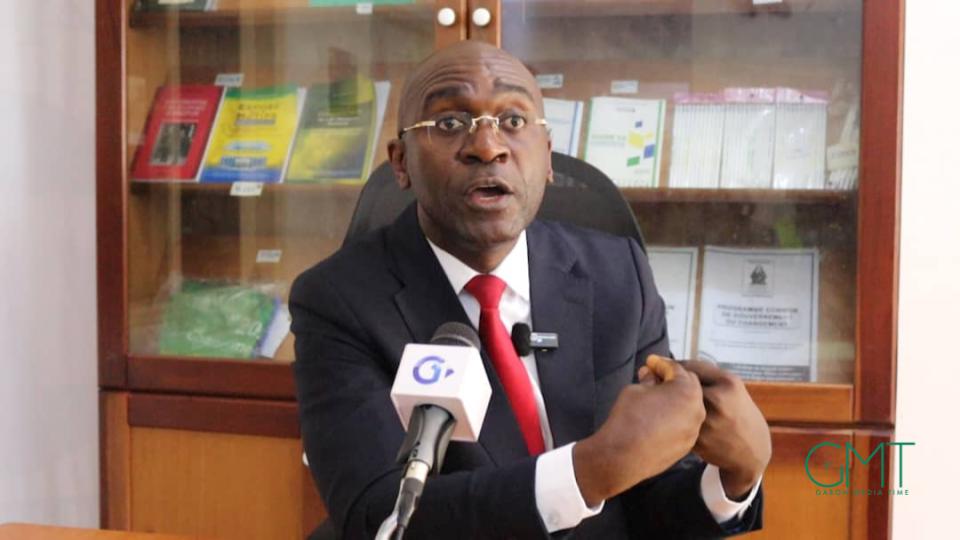
In a recent press conference in Libreville, civil society leader Geoffroy Foumboula Libeka Makosso sharply criticized the escalating wave of inflammatory and defamatory remarks attributed to certain Gabonese activists based abroad. While acknowledging the legitimacy of political dissent, he drew a clear line between free speech and outright verbal abuse, particularly when such attacks target the President of the Republic, Brice Clotaire Oligui Nguema, his spouse, and his mother. Foumboula Makosso also urged authorities to move beyond symbolic condemnation and take judicial action when laws are violated.
The activist, known publicly under the pseudonym Lanlaire, has been at the center of controversy for recent remarks that crossed the threshold from robust criticism to personal insults. Foumboula Makosso emphasized that while public debate can be intense, it must not descend into personal attacks that undermine the dignity of state institutions or their representatives.
Drawing boundaries between free speech and defamation
Foumboula Makosso, whose own advocacy work has consistently relied on legal and constitutional means, rejected the notion that opposition to authority justifies personal insults. He stressed that criticism of governance is essential in a democracy, but it must not be weaponized through slander, defamation, or public insults—acts he described as criminal offenses, not expressions of free speech. « Insults and defamation are crimes, not democratic tools », he stated firmly, urging that legal consequences follow when these boundaries are crossed.
He went on to warn that failing to hold individuals accountable for such behavior risks normalizing verbal aggression as a pathway to influence or visibility. « When outbursts go unchallenged in court, they send a dangerous message », he warned, suggesting that impunity could encourage further misuse of public discourse.
Questioning ties between authorities and controversial activists
Beyond naming the activists responsible, Foumboula Makosso raised concerns about the reported interactions between government officials and certain diaspora figures whose rhetoric has been consistently hostile toward the administration. He cited instances where activists were allegedly invited to Gabon, featured on state media, or consulted during official visits—actions that, if proven, could blur the line between dialogue and endorsement.
Among the claims he presented was a serious allegation that one activist received €150,000 (approximately 100 million FCFA) from a member of the presidential delegation in exchange for public insults targeting the Head of State. While presented as an account from the conference, the claim remains unverified and lacks judicial confirmation.
Demanding accountability to preserve national dignity
Foumboula Makosso called on the presidency and state institutions to sever ties with individuals whose primary contribution to public life appears to be inflammatory rhetoric. « The Republic’s image is at stake », he declared, urging that no form of verbal abuse be tolerated or rewarded with access or influence. He argued that silence in the face of such behavior—whether through inaction or half-hearted condemnation—risks being interpreted as tacit approval, thereby emboldening further abuse.
A call for legal action and digital responsibility
In a broader appeal to the justice system, Foumboula Makosso demanded that prosecutors pursue charges against those responsible for defamatory or insulting statements. He cautioned that without decisive legal intervention, public opinion may conclude that certain voices operate above the law. « Justice must not be selective », he insisted.
He also addressed Gabonese internet users, urging them to take a stand against the spread of abusive content by refusing to amplify it through shares, likes, or follows. Instead, he encouraged the use of platform reporting tools to curb the viral reach of harmful speech.
As the nation reflects on the quality of its public discourse, Foumboula Makosso’s stance underscores a critical principle: in a democracy, dissent is vital—but it must never become a tool of humiliation or a substitute for reasoned debate.