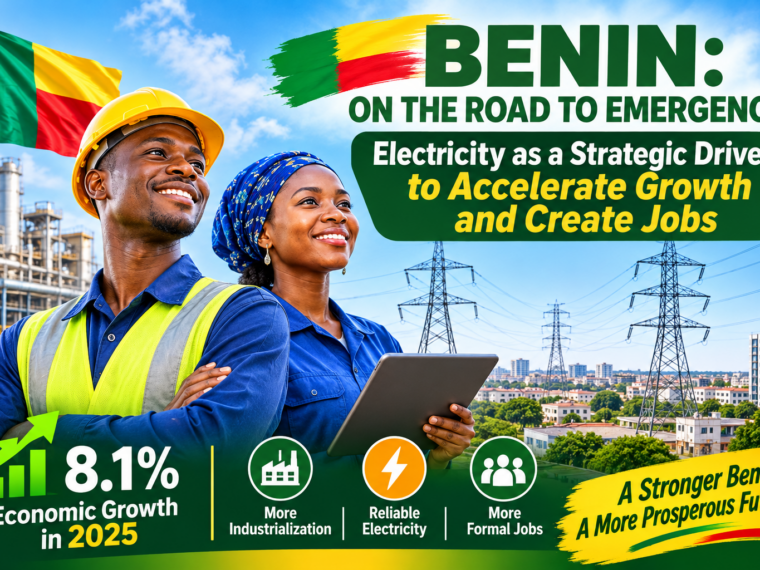
Benin’s 8.1% growth hides a stark employment paradox
While Benin boasts an impressive 8.1% economic expansion in 2025 placing it among West Africa’s fastest-growing economies the surge in GDP figures contrasts sharply with labor market realities. A report indicates that in 2022, 96.3% of workers operated in the informal sector, with only 19.8% holding formal wage jobs. Among youth, the figure drops to just 9%. The disconnect reveals a critical gap: growth alone is not translating into stable, productive employment.
Industrial zones light the path to formal jobs
Investments in industrialization are beginning to bridge this divide. The Glo-Djigbé Industrial Zone (GDIZ), for instance, employed 22,798 workers in 2025 a 28.8% jump from 2024. This progress highlights how targeted industrial development can generate higher-quality jobs, particularly in agro-processing, textiles, and manufacturing. Yet, without consistent electricity, these gains remain fragile.
Power cuts strangle competitiveness and profitability
Nearly half of Beninese businesses cite unreliable electricity as a major obstacle to operations. Compounding the issue, 86.1% of firms report frequent outages, forcing costly workarounds like backup generators. For small manufacturers and exporters, such disruptions translate into lost raw materials, delayed shipments, and eroded market share. The energy crisis extends beyond production: in 2024, transmission losses hit 24.7%, while half of the country’s power lines and transformers exceeded 25 years of service life. Rising fuel costs, driven by limited natural gas supply, further strain budgets.
Mission 300 targets a 159,000-job boost by 2030
The World Bank’s Mission 300 initiative, in partnership with the African Development Bank, aims to connect 300 million Africans to electricity by 2030. For Benin, this translates into a national energy pact focused on scaling production, modernizing infrastructure, and mobilizing private investment. Key projects include four new solar plants (Natitingou, Djougou, Bohicon, Parakou) with a combined 50 MW capacity, alongside the 128 MW Onigbolo thermal plant. Together, these developments could unlock or sustain up to 159,000 jobs but only if execution aligns with long-term reforms.
From power shortages to economic resilience: the path ahead
Reliable supply: Reducing outages through upgraded grids and diversified energy sources.
Cost efficiency: Cutting losses to lower tariffs for businesses and households.
Governance overhaul: Strengthening sector management to attract investment and accelerate connections.
Youth integration: Prioritizing access for young entrepreneurs and small-scale producers to formal employment.
Measuring success beyond GDP growth
The true benchmark for Benin’s economic model will not be headline growth rates but tangible outcomes: the number of formal jobs created, the productivity of enterprises, and the reliability of electricity. With 8.1% expansion in 2025, the foundation is strong. The challenge now is ensuring every watt of progress translates into lasting opportunities for businesses, workers, and the nation’s future.
By Thomas Nkoulou — Journalist