Burkina Faso’s military ruler declares democracy obsolete for the nation
Photo credit: TASS via Reuters
- Temps de lecture: 5 min
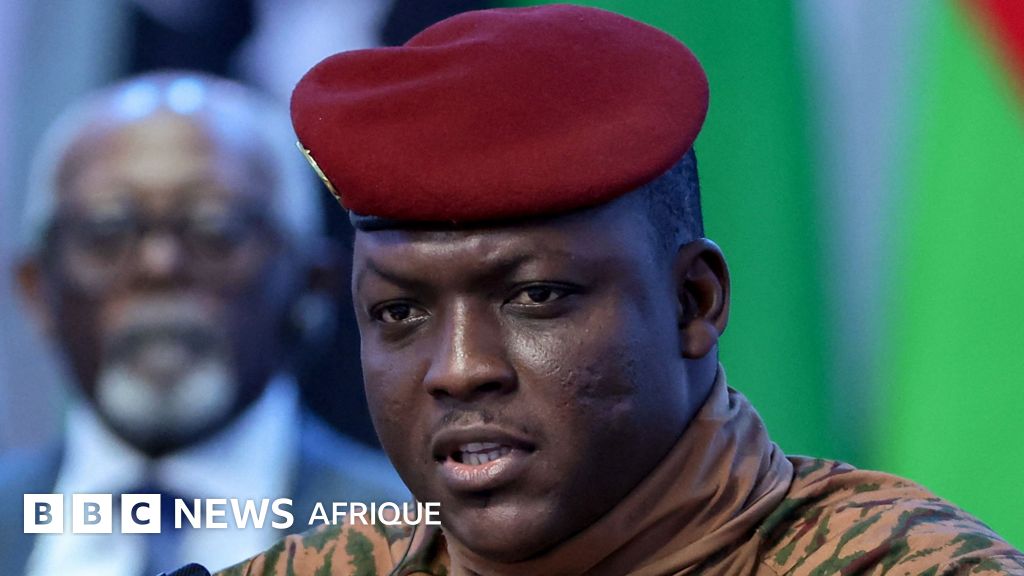
During a nationally televised interview on Thursday evening, Burkina Faso’s military leader, Captain Ibrahim Traoré, made a striking declaration: “People must forget about democracy. It is not for us.” The 38-year-old self-proclaimed revolutionary leader, who seized power three years ago, argued that the Western-backed democratic model has brought nothing but suffering to Africa.
Traoré’s comments came just two months after his junta extended his rule by five years, effectively postponing the democratic transition he had initially promised by July 2024. In January, the government banned all political parties, citing the need to “rebuild the state.”
The military ruler framed democracy as a destructive force, warning: “Wherever Western powers impose democracy, bloodshed follows.” He pointed to Libya as a cautionary example—once a stable nation under Muammar Gaddafi’s authoritarian regime, now a fractured state divided by rival administrations and armed groups following his violent overthrow in 2011.
Traoré, who positions himself as a champion of anti-imperialism, has outlined a radical alternative to democracy. He dismissed traditional politicians as corrupt figures—“liars, flatterers, and empty speakers”—and vowed to dismantle the political establishment entirely. “We have our own approach. We are not copying anyone,” he stated. “We are here to completely change how things are done.”
The junta’s new vision emphasizes sovereignty, patriotism, and revolutionary mobilization, with traditional leaders and grassroots structures playing a central role. Traoré also stressed the need for economic and military self-reliance, arguing that Burkina Faso cannot progress with standard six- or eight-hour workdays. “Hard work is the only way forward,” he insisted.
Since taking power, Traoré has systematically suppressed dissent, targeting opposition figures, media outlets, and civil society groups. Critics have accused his government of silencing opponents by sending them to the frontlines of the brutal fight against Islamist militants—a conflict that has ravaged the country for over a decade.
Despite widespread repression, Traoré has cultivated strong support across Africa for his uncompromising stance against Western influence. Like neighboring juntas in Mali and Niger, Burkina Faso has severed ties with France and other Western partners in its counterterrorism efforts, instead turning to Russia for military assistance. Yet violence in the region continues unabated.
According to Human Rights Watch, over 1,800 civilians have been killed in Burkina Faso since Traoré’s coup in 2023. The report attributes two-thirds of these deaths to state forces and allied militias, with the remainder linked to Islamist extremists.
Traoré’s rejection of democracy marks a dramatic shift in Burkina Faso’s political trajectory, raising questions about the country’s future stability and its alignment with broader regional trends.