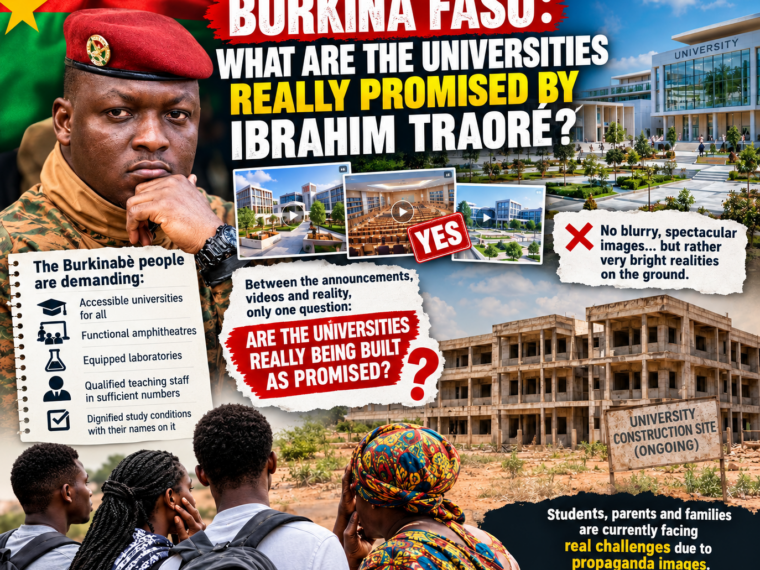
Behind the polished images shared online lies a pressing question: how many of Burkina Faso’s heralded universities actually exist today, and what can students and families expect to find?
From digital spectacle to campus reality
Viral videos and social media posts have painted a picture of rapid modernization in Burkina Faso’s higher education sector. Yet for parents investing in their children’s future, and for students preparing for university, the gap between these images and tangible improvements remains stark.
Verified progress or digital manipulation?
Recent investigations have exposed cases where videos and photos attributed to Burkina Faso’s development projects were either misrepresented or entirely fabricated. In 2025, false claims circulating online included images of buildings in Algeria presented as new universities in Burkina Faso, raising concerns about the authenticity of visual evidence used in national narratives.
While such manipulations primarily targeted general infrastructure claims, the same risk applies to university projects. Without ground-level verification, it becomes difficult to distinguish between genuine construction and digitally generated content designed to boost public perception.
Announcements versus accessible education
Government statements have highlighted several university projects, including the inauguration of a 1,200-seat amphitheater and six laboratories at Nazi-Boni University in Bobo-Dioulasso in September 2026. Additional complexes were announced under the presidential initiative for quality education. But progress reports often stop at ribbon-cutting ceremonies.
Announced projects may remain unbuilt — groundbreaking events do not always lead to completed infrastructure.
Completed buildings may lack equipment — lecture halls and labs may exist without functioning technology or teaching staff.
Inaugurated facilities may still face operational delays — student enrollment, utility access, and administrative readiness are not guaranteed.
Families and students need more than visual proofs. They require verifiable data on infrastructure availability, student intake capacity, and operational readiness.
AI-generated content: a growing challenge
The rise of artificial intelligence tools has made it easier to create convincing fake videos and images. While not all misleading content is linked to official sources, the proliferation of synthetic media complicates public trust. The critical test for any government lies in how it addresses misinformation: does it provide transparent evidence, allow independent scrutiny, and facilitate open verification?
Counting what truly exists
A rigorous assessment of Burkina Faso’s higher education sector must go beyond announcements. The following criteria should be examined:
Physical completion — Are the buildings standing and in usable condition?
Operational functionality — Are classrooms furnished, labs equipped, and utilities operational?
Student access — Are enrollment processes open, fees affordable, and transport options available?
Academic staff — Are there enough qualified lecturers to run the programs?
Long-term sustainability — Are funding mechanisms in place for maintenance and future expansion?
Without independent audits and public reports, the gap between promise and delivery will continue to fuel skepticism among those most affected: students and their families.
What students are actually seeing on campus
Reports from Bobo-Dioulasso indicate that the new facilities at Nazi-Boni University are being used, with scheduled lectures and research activities underway. However, demand continues to outstrip capacity. Several students interviewed in early 2027 noted improved conditions but also persistent challenges such as overcrowded classrooms and limited lab access.
While progress is evident, it is uneven and partial. Not all announced projects have broken ground, and some existing facilities remain underutilized due to logistical or administrative hurdles.
A call for transparency and accountability
The credibility of Burkina Faso’s higher education strategy hinges on more than viral imagery. It rests on verifiable facts: completed buildings, open enrollment, equipped labs, and functioning administration. Students do not study in videos they study in lecture halls. Families do not invest in promises they invest in real opportunities.
The government must move beyond staged presentations and provide accessible, regularly updated records of project status. Only then can the public judge whether the promised universities are truly part of Burkina Faso’s future or merely part of a digital illusion.
By Thomas Nkoulou — Journalist