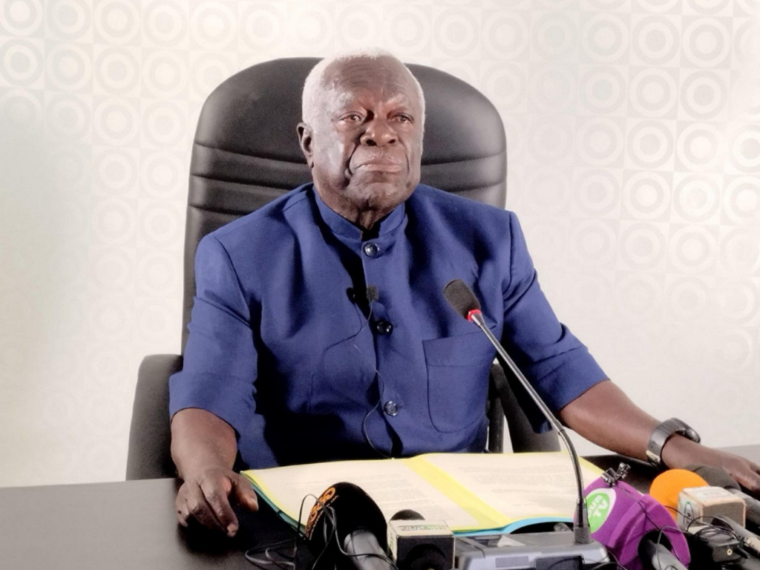
Gabon’s judicial system has taken a decisive step in the high-profile case involving former police general and ex-minister Jean-Boniface Assélé. At 87 years old, Assélé now faces prison time after being charged with attempted murder and illegal firearm possession in connection with a shooting that left a 12-year-old boy gravely injured during a football match in Libreville.
From football field to prison: the fall of a Gabonese heavyweight
The incident unfolded on the evening of November 13, 2026, at the Sibang Augustin-Monedan stadium in Libreville’s sixth arrondissement. What began as an ordinary youth football game ended in chaos when Jean-Boniface Assélé, accompanied by his son, allegedly brandished a 16-gauge shotgun and opened fire. The bullet struck 12-year-old Jason Merlin Midioko, known as Dylan, in the right flank, causing severe injuries.
According to prosecutors, Assélé left the scene shortly after the shooting before voluntarily surrendering to judicial police the following night. An initial investigation was launched to determine the precise circumstances of the shooting and establish accountability.
The case has ignited widespread public outrage, with social media users rallying under the hashtag #JusticeForDylan, demanding transparency and full accountability for the incident.
Dylan’s fight for recovery amid mounting national pressure
The immediate aftermath saw young Dylan rushed to the Jeanne-Ebori Mother-Child University Hospital in Libreville, where he underwent emergency surgery and was placed in intensive care. Medical reports indicated gradual stabilization, though a projectile remained lodged in a critical area, requiring ongoing monitoring.
President Brice Clotaire Oligui Nguema visited Dylan’s bedside on November 16, ordering full coverage of his medical evacuation costs. The ministers of Social Affairs and Health also mobilized support for the boy and his family, reflecting the gravity of the situation on national policy levels.
Assélé’s fall from power: justice without exceptions
Jean-Boniface Assélé is no ordinary defendant. The 87-year-old former army officer served multiple ministerial roles under former President Omar Bongo, including as commander of the national police force and president of the reformist liberal circle (CLR). His decades-long political career once positioned him among Gabon’s most influential figures.
Yet, despite his storied past, Assélé’s high-profile status did not shield him from prosecution. On November 16, following his arraignment before Libreville prosecutors, he was remanded to the central prison of Libreville in Gros-Bouquet. The judge ordered his detention on provisional charges of attempted murder and illegal firearms possession, marking the start of a formal judicial inquiry.
Under Gabonese law, Assélé remains presumed innocent until proven guilty. The judicial process will now scrutinize evidence, examine witness accounts, and determine the exact sequence of events.
Equality before the law: the case that tests Gabon’s legal principles
Beyond the personal tragedy, the Assélé case raises pivotal questions about judicial equality in Gabon. When a former high-ranking official faces criminal charges, it tests public confidence in the justice system’s impartiality.
During his hospital visit, President Oligui Nguema reaffirmed the principle that “justice is the same for everyone.” His statement underscores the significance of the moment: a case involving a prominent figure is being handled through standard judicial procedures, signaling a potential shift in accountability standards.
Meanwhile, the Assélé family has publicly expressed regret over the incident and initiated steps to support Dylan’s treatment and recovery.
Next steps: what remains to be resolved in the Dylan shooting case
Critical questions still demand answers. What prompted the use of a firearm? What were Assélé’s intentions? Were proper protocols followed regarding the use of the stadium? And what role, if any, did others present play in escalating the situation?
These questions now fall under the scrutiny of the examining magistrate, who will conduct a thorough and balanced investigation. In parallel, Dylan continues his recovery journey, his family awaiting justice not just for their son, but for accountability across Gabon’s legal and political landscapes.
From a football field in Sibang to the prison cells of Gros-Bouquet, this case reaffirms a fundamental truth: in Gabon, as in any democracy, no individual—regardless of past status—is above the law.
The justice system now holds the responsibility to deliver truth, transparency, and fairness in a case that has gripped the nation.