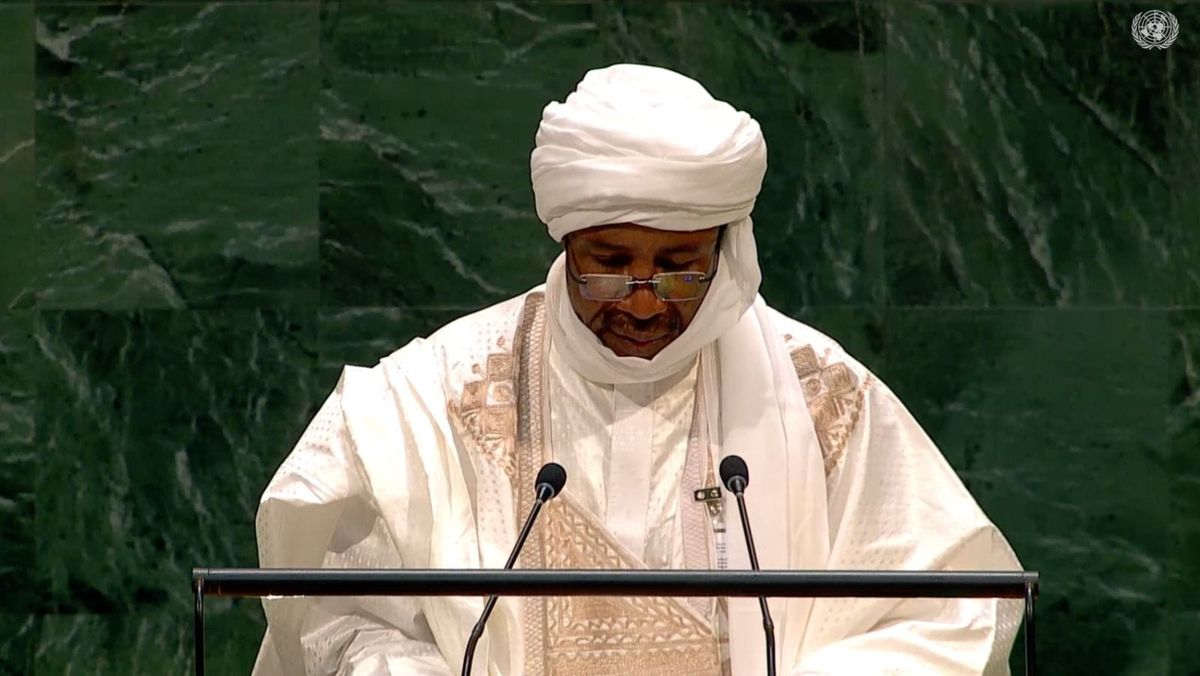
The question now looms large on the global stage: as Chad raises the stakes at the United Nations, is the world prepared to confront the growing threat of unauthorized airstrikes on sovereign soil?
Chad’s UN envoy delivers a pivotal message under mounting pressure
Delivering a strong rebuke on behalf of President Mahamat Idriss Déby Itno, Chad’s Health Minister Abdelmadjid Abdelrahim Mahamat stood at the podium of the 81st United Nations General Assembly. With every word, he underscored the nation’s unwavering commitment to regional stability—a commitment built on diplomacy, humanitarian action, and an unshakable defense of territorial integrity.
But beneath the measured tone lay an urgent warning. Chad’s historic role as a stabilizing force in the Sahel was no longer enough. The nation demanded accountability for what it describes as flagrant violations of its airspace, particularly in the eastern Ennedi region, where recent airstrikes have left its sovereignty in question.
Defending sovereignty: Chad challenges the international community
Chad’s diplomatic offensive at the UN was not merely rhetorical. It was a calculated assertion of national pride and security. Speaking directly to global leaders, the minister reminded the assembly of Chad’s indispensable contributions to international peacekeeping—including the deployment of 1,500 troops to Haiti under a UN-mandated stabilization mission.
Yet, as Chad champions multilateralism abroad, it faces a growing crisis at home. The nation currently hosts over two million displaced persons, including more than one million Sudanese refugees fleeing conflict since April 2023. The minister emphasized that while Chad remains neutral in the Sudanese civil war, it will not tolerate aggression on its own territory. “These airstrikes are not just acts of war—they are acts of provocation,” he declared, signaling that further incursions could prompt a firm response.
From humanitarian burden to security alarm: the dual crisis at Chad’s doorstep
The Ennedi-East strikes are not isolated incidents. They represent a dangerous escalation in a region long plagued by instability. Chad’s leaders insist these violations extend beyond mere border disputes—they threaten the very fabric of national sovereignty. And with the nation already stretched thin by humanitarian crises and regional conflicts, the stakes have never been higher.
The minister also highlighted Chad’s long-standing advocacy for climate justice, urging developed nations to fulfill financial commitments aimed at strengthening resilience in the Lake Chad Basin—a region battered by drought, desertification, and displacement. “Stability cannot be built on broken promises,” he stated, tying environmental neglect to broader security risks.
Will Chad’s bold stance at the UN shift the calculus of regional power?
The international community now faces a critical choice: will it respond with condemnation, with silence, or with meaningful action to deter future violations? Chad’s message was clear—its patience is not infinite, and its sovereignty is non-negotiable.
As the UN General Assembly continues its deliberations, the world watches closely. Will these words translate into real-world consequences for those responsible? Or will Chad’s red line remain unheeded, emboldening further aggression in a region already on the brink?
What’s next for Chad and its partners?
- Diplomatic escalation: Chad has signaled it will pursue all diplomatic avenues, including potential sanctions or referrals to international bodies, to hold accountable those behind the airstrikes.
- Military readiness: Although no immediate troop movements have been announced, the minister’s warning leaves little doubt that Chad is prepared to defend its airspace by all necessary means.
- Humanitarian strain: With over two million displaced persons already within its borders, any further destabilization could trigger a humanitarian catastrophe.
- Regional alliances: Chad may seek stronger partnerships with neighboring states and regional blocs to reinforce collective security against external threats.
A turning point for Africa’s response to sovereignty violations?
Chad’s bold stand at the United Nations may mark a watershed moment—not only for the nation itself but for the broader African continent. In an era where airspace incursions and cross-border aggression are increasingly normalized, Chad’s refusal to accept impunity sends a powerful message: no nation’s sovereignty is negotiable.
As the dust settles on the UN podium, one question remains: will Africa’s voice finally be heard?