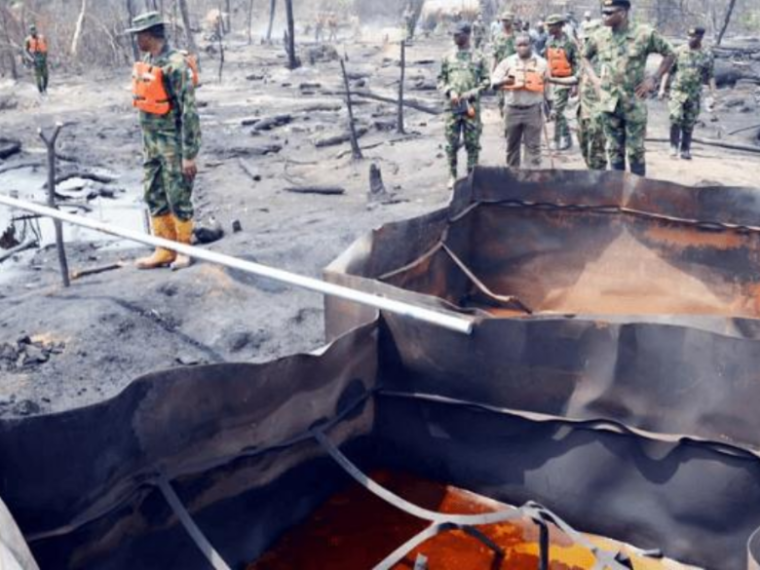
Nigerian authorities have dismantled a massive illegal oil refining operation in Ogun State, raising serious concerns about the nation’s struggle to control its hydrocarbon resources. The clandestine facility, reportedly operated by foreign nationals, was discovered in Ogere during a raid conducted by the Economic and Financial Crimes Commission (EFCC).
What authorities found at the illegal refinery site
The secret facility spanned over three hectares and contained industrial equipment including underground storage tanks, heating systems, separation devices, and cooling installations. One of the storage tanks was estimated to hold 90,000 liters of processed fuel, indicating the scale of operations.
Investigators determined that operators were using discarded petroleum residues—commonly referred to as “black sludge”—sourced from locations such as Warri in Delta State and Port Harcourt in Rivers State. These materials were chemically processed and refined into what inspectors identified as diesel, known locally as Automotive Gas Oil (AGO).
The entire operation was reportedly conducted without regulatory approvals or official documentation.
Tracing the supply chain and distribution networks
While the refinery was found abandoned during the raid, the discovery underscores a larger, more complex issue: the existence of a hidden logistics network enabling illegal oil refining.
Questions remain unanswered about how raw materials were consistently transported over hundreds of kilometers, stored securely, and processed without detection. Authorities are now investigating the financial backers, suppliers, and end customers connected to this clandestine operation.
The investigation also probes potential local complicity—whether officials, community leaders, or security personnel facilitated the refinery’s existence through oversight, tolerance, or direct involvement. However, no institutional involvement has been confirmed as the probe continues.
Environmental and economic fallout of illegal oil refining
Environmental hazards
Unregulated oil refining poses severe risks. The use of makeshift equipment and absence of pollution control measures can lead to toxic emissions, soil contamination, and groundwater pollution. Fire hazards, explosions, and exposure to hazardous chemicals also threaten nearby communities and ecosystems.
Economic consequences and unfair competition
Illegal refineries operate outside Nigeria’s tax and regulatory framework, depriving the government of vital revenue. They undercut legitimate businesses that comply with environmental and safety standards, creating an uneven playing field. Additionally, the uncertified fuel produced risks damaging vehicles and industrial machinery, posing long-term economic costs.
Foreign involvement and sovereignty concerns
This incident comes amid growing scrutiny over foreign economic activities in Nigeria’s strategic sectors. Chinese enterprises and nationals have expanded presence across industries including mining, infrastructure, and energy. While this refinery’s operation raises questions about oversight of foreign actors, there is no evidence linking it to a state-backed Chinese initiative.
The critical challenge for Nigerian authorities is enforcing national laws regardless of the nationality of those involved. Ensuring regulatory compliance and protecting sovereign control over natural resources remain top priorities.
Nigeria’s uphill battle for oil sector control
This discovery is not just an enforcement case—it highlights Nigeria’s ongoing struggle to monitor, regulate, and secure its oil industry. The next phase of the investigation will focus on identifying operators, tracing financial flows, and establishing legal liability.
This situation serves as a stark reminder: abundant natural resources do not equate to economic sovereignty unless a nation can enforce its legal and regulatory authority. The illegal refinery in Ogun State is more than a crime—it’s a test of Nigeria’s ability to protect its strategic assets and maintain control over its own territory.