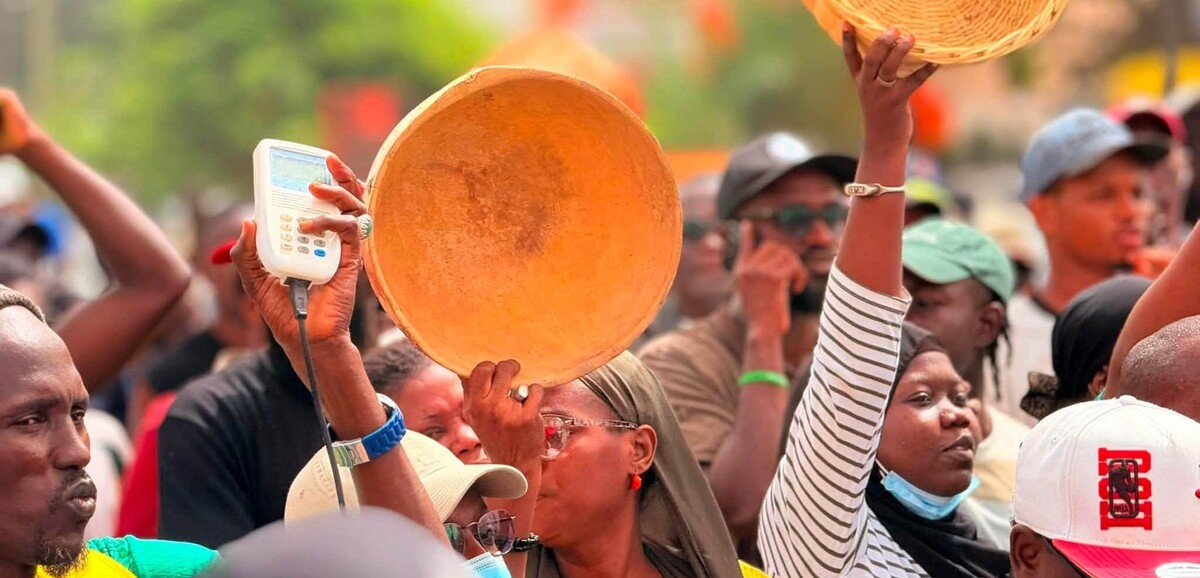
The campaign against soaring living costs in Senegal moved from online platforms to the streets on Saturday. On 5 September, dozens of demonstrators gathered in Dakar for the ‘March of Empty Baskets’, part of the ’30 Days for the Right Price’ initiative. The procession began in the Castors district and ended at the Jet-d’Eau roundabout.
Protesters carried empty baskets, bowls, and kitchen utensils as a powerful symbol of the struggles households face in covering daily expenses. Placards and chants highlighted demands related to food prices, housing costs, and electricity bills, particularly the prepaid Woyofal system.
Movement sparked online
The campaign originated on social media a few days earlier. ’30 Days for the Right Price’ was launched by consumers and content creators denouncing the rising cost of living and calling for measures to boost purchasing power.
Before the march, the movement claimed over 3,000 supporters. It also urged a gradual boycott of certain overpriced items. Influencer Bathie Drizzy, one of the co-founders, stressed the apolitical nature of the initiative after the march. ‘No political figure is behind us,’ he said, explaining that the goal is to draw authorities’ attention to the population’s hardships.
Prices fuel anger
The campaign is rooted in concrete concerns. Reports highlighted increases in meat prices: beef, previously around 4,000 CFA francs per kilogram, could now reach 5,500 CFA francs, while mutton was sold up to 7,000 CFA francs in some outlets. These figures are based on market surveys and do not represent an official national price.
The issue now extends beyond food. Demonstrators also raised concerns about rents, electricity, and other daily expenses. This broadening of demands gives the movement wider significance than a simple protest over a few products.
Political pressure mounts
Saturday’s march drew political reactions, including from Aldiouma Sow, described as an advisor to President Bassirou Diomaye Faye. In a Facebook post, he sharply criticized the mobilization and urged young participants to focus on work, denouncing what he called ‘populist messianism.’
This response is not an official government position, but it indicates the movement is prompting reactions within the presidential camp.
Meanwhile, the high cost of living continues to dominate Senegal’s press review this Monday, 7 September, showing the issue extends beyond the weekend’s events.
Movement vows to continue
Organizers do not view the march as a one-off event. Following the rally, the ’30 Days for the Right Price’ collective praised the turnout and announced further actions. The question now is whether this campaign can sustain momentum in public discourse and elicit concrete responses from authorities.
The government had recently prioritized purchasing power, prices, and rents. The Council of Ministers on 2 September called for strengthening price control measures and accelerating rent regulation. The ’empty baskets’ protest thus emerges in a context where street pressure and government announcements converge on the same issue: the daily household budget in Senegal.
A protest to watch
For now, the movement is primarily driven by citizens and social media activists. It is not yet a national, politically structured mobilization. However, its potential is significant: it touches on food, housing, electricity, and purchasing power—concerns that affect a large portion of the population. Unlike typical political controversies, the ’empty baskets’ question is straightforward: what does daily life cost for a Senegalese household today, and what can the government realistically do to make it more affordable?