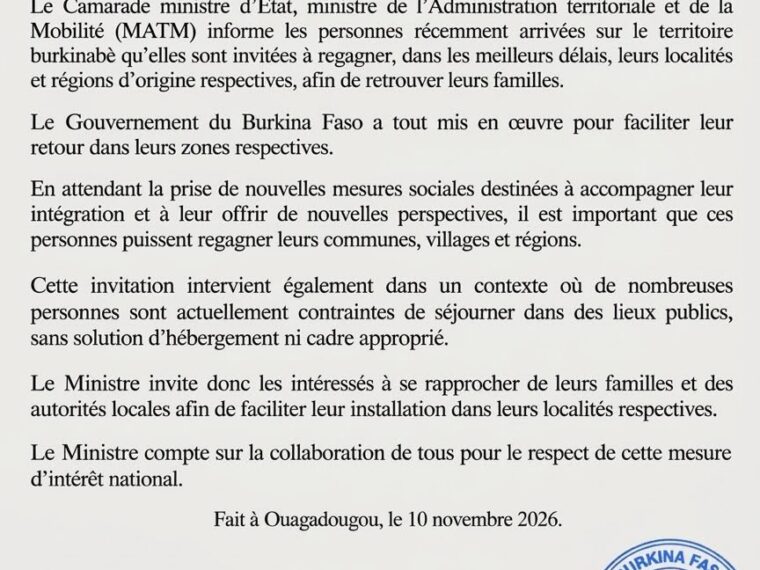
The stark reality facing Burkina Faso today is laid bare by the forced return of thousands of Burkinabè gold miners from Guinea. As the government champions economic sovereignty and resource nationalization, the fate of these expelled miners exposes a critical gap: the absence of a concrete, actionable plan for their economic reintegration.
Empty promises of an economic renaissance
Political rhetoric promoting self-reliance and national dignity contrasts sharply with the immediate aftermath of the expulsions. Rather than rolling out structured programs with clear timelines, funding, and measurable outcomes, authorities have simply urged the repatriated miners to return home. This administrative directive, cloaked as a solution, does little more than address the immediate logistical challenge of their return.
Unemployment looms for returned miners
These young Burkinabè did not journey to Guinea on a whim; many turned to artisanal gold mining out of necessity, as it often represented their only source of income to support their families. The loss of this livelihood upon expulsion creates a cascade of economic instability: shattered income streams, compromised family projects, and a sudden return to precarity. The question now is whether the state can provide viable alternatives or if these miners will simply be abandoned to unemployment once more.
The government’s inability to address this issue underscores a fundamental flaw in its approach to sovereignty. While declarations of reclaiming national resources resonate in political speeches, they ring hollow if the state cannot translate mineral wealth into tangible employment and income for its people.
Proposed solutions fall short of transformative change
Officials have floated several options for reconversion, including agriculture, livestock rearing, vocational training, and cooperative formation within the mining sector. On the surface, these may seem like reasonable pathways. In practice, however, they overlook critical barriers:
Access to land and resources: Agriculture and livestock require arable land, equipment, seeds, and technical support none of which are guaranteed.
Capital constraints: Many returnees arrive with depleted savings, making it impossible to fund a new venture independently.
Market accessibility: Artisanal products need viable trade channels to reach consumers; without them, small-scale entrepreneurs remain trapped in poverty.
A two-week training course or the formation of a cooperative on paper does not equate to sustainable economic integration. Without sustained funding, equipment, and post-reinsertion monitoring, these measures risk becoming little more than empty gestures.
The financing dilemma: a make-or-break challenge
Access to capital remains the linchpin of any viable reinsertion strategy. Many expelled miners likely exhausted their savings to finance their journey home, leaving them with no financial cushion to restart their lives. A robust reinsertion program must include startup funds, microcredit options, public guarantees, and entrepreneurial mentorship tailored to individual circumstances, such as prior agricultural experience versus no alternative skills.
Beyond individual hardship, the social fallout is severe. These miners often supported entire families; their loss of income destabilizes households, threatens education for children, and compounds financial burdens. A blanket injunction to “find another way” ignores the structural vulnerabilities that force many into informal economies in the first place.
A mining policy that must include the informal sector
President Ibrahim Traoré’s vision of mineral sovereignty cannot ignore the plight of artisanal miners, who have long powered part of the country’s gold economy. A genuine reclamation of mining resources requires policies that:
Regulate artisanal mining sites: Establish legal frameworks for safe, formalized exploitation.
Improve working conditions: Reduce risks of accidents and environmental harm.
Support functional cooperatives: Provide capital, equipment, and market linkages.
Formalize gold trading: Create official purchase circuits to combat illicit trade.
Without such measures, the state risks perpetuating the very conditions that push people toward clandestine or unsustainable livelihoods. The paradox is glaring: a government that declares mastery over its gold wealth must also offer a tangible path forward for the citizens who once extracted it.
The Ibrahim Traoré administration’s moment of reckoning
This episode serves as a litmus test for Traoré’s leadership. While condemning the expulsions and defending national dignity are necessary, they are not sufficient. The government’s credibility hinges on its ability to deliver tangible outcomes: employment, income, and stability for the repatriated miners.
Key questions remain unanswered: How many returnees will secure gainful employment in the coming months? Who will access financing for reconversion? Which mechanisms will track their long-term integration? Until these are addressed, the government’s reinsertion promises risk collapsing into hollow political posturing.
The core issue is not merely that these miners were expelled from Guinea. It is that, upon returning, they may find themselves trapped in the same economic despair that drove them abroad initially. True sovereignty is not proclaimed in speeches it is measured by the state’s capacity to provide work, income, and dignity to its citizens. On this front, Ibrahim Traoré’s government is now under scrutiny for results, not rhetoric.
By Thomas Nkoulou — Journalist
