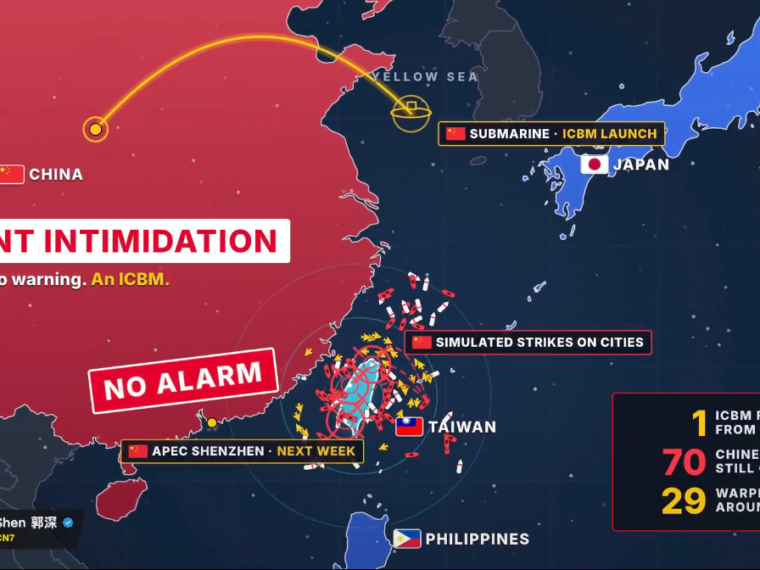
Military tensions in the Western Pacific have escalated sharply after China deployed over 100 naval and coast guard vessels in a sweeping operation off the coast of Taiwan. The surprise maneuver, which unfolded throughout early November 2026, has intensified scrutiny of Beijing’s strategic intentions and prompted unusual U.S. aerial activity in the region.
China’s massive naval exercise tests regional stability
Taiwanese defense officials confirmed on November 13 that more than 100 Chinese military ships and coast guard vessels were actively deployed near the island and adjacent waters. The operation, conducted without prior announcement, drew participation from naval forces across China’s Eastern, Northern, and Southern Fleets, signaling an unprecedented level of coordination.
The drills included simulations of attacks targeting both military assets and civilian infrastructure, raising concerns about China’s growing capacity to isolate Taiwan in a crisis. By November 13, approximately 70 ships remained in the area of the First Island Chain—a critical maritime boundary stretching from Japan to the Philippines.
Military analysts warn that such exercises could serve as a rehearsal for a potential blockade, cutting off Taiwan’s sea and air access while exerting economic and geopolitical pressure. The Institute for the Study of War highlighted this risk, noting that China may be refining strategies to deny access and sever supply lines to Taipei.
U.S. ‘Nuclear Sniffer’ aircraft spotted over Taiwanese waters
Against this backdrop, a U.S. Air Force WC-135R Constant Phoenix—commonly known as the ‘Nuclear Sniffer’—was detected flying a mission near Taiwan on November 15. The aircraft, which departed from Okinawa, Japan, followed a route south of the island before heading toward the southwestern approaches of the Taiwan Strait.
The WC-135R is a specialized reconnaissance plane equipped to detect trace amounts of radioactive particles and gases in the atmosphere. Its primary role involves monitoring nuclear activity and radiological incidents, though its exact mission in this instance remains unconfirmed by U.S. authorities.
While the aircraft’s presence may suggest heightened U.S. vigilance over Chinese military movements, no evidence links it directly to nuclear detection or a specific crisis scenario. The ambiguity surrounding its objectives underscores the delicate balance of power in the region.
How Taiwan’s security dilemma affects global interests
As Beijing asserts its territorial claims over Taiwan and Washington reinforces its commitment to Taipei’s defense, the stakes could not be higher. The island sits at the heart of critical global supply chains, particularly for advanced semiconductor manufacturing—a vulnerability that could trigger widespread economic disruption in the event of conflict.
Japan, a key U.S. ally with strategic proximity to Taiwan, has also been drawn into the evolving security landscape. Meanwhile, regional observers warn that any miscalculation or escalation could destabilize trade routes and trigger broader geopolitical confrontations.
The Pacific is no longer just a theater of shadow diplomacy; it has become a potential flashpoint where every military move is examined under a microscope. The convergence of China’s naval surge and U.S. surveillance flights has set the stage for an increasingly volatile standoff.
Key takeaways
- China’s deployment of over 100 naval vessels near Taiwan marks a bold demonstration of military force, raising questions about its long-term intentions.
- A U.S. WC-135R aircraft—specialized in nuclear detection—was observed flying near Taiwanese waters, fueling speculation about American monitoring efforts.
- The situation underscores Taiwan’s pivotal role in global supply chains, particularly in semiconductor production, making any conflict a potential economic crisis.
- With no clear resolution in sight, the region faces heightened uncertainty over whether diplomatic efforts can keep pace with rising militarization.