Gilbert Houngbo secures second term at ILO amid explosive financial and labor disputes
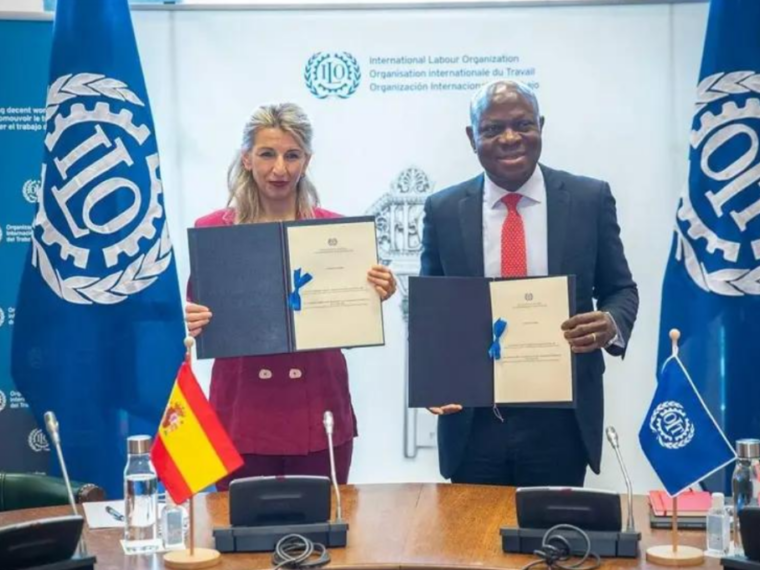
Gilbert Houngbo has been re-elected unopposed as Director-General of the International Labour Organization (ILO), following the last-minute withdrawal of his main opponent, Spanish Labour Minister Yolanda Díaz, just days before the November 16, 2026 vote. While Díaz framed her decision as an effort to maintain unity within the global labour movement, she delivered a scathing critique of the outgoing administration, accusing it of plunging the UN agency into severe financial distress and undermining social dialogue at its core.
 Gilbert Houngbo’s re-election marks a pivotal moment for the International Labour Organization. As the Togolese diplomat begins his second five-year term, he faces immediate pressure to address financial instability, workforce tensions, and mounting skepticism from key stakeholders.
Financial instability at the heart of growing discontent
Yolanda Díaz’s withdrawal was accompanied by sharp condemnation of the ILO’s financial management under Houngbo’s leadership. She described the organization as experiencing one of its most severe financial crises in history, exacerbated by delayed and unpaid dues from member states—most notably the United States, a top contributor.
In response to the funding shortfalls, the ILO has initiated drastic cost-cutting measures, including staff reductions and operational restructuring. However, critics argue that these measures disproportionately affect workers within the organization rather than addressing systemic financial inefficiencies. Díaz went so far as to accuse the leadership of undermining the ILO’s social mission by prioritizing budgetary survival over its founding principles of workers’ rights and justice.
The union representing ILO staff has echoed these concerns, raising alarms over restructuring decisions and the erosion of social dialogue mechanisms. Díaz emphasized that an institution tasked with promoting workers’ rights globally should not fail to uphold those same rights internally.
Eroding trust: the collapse of social dialogue at the ILO
The second major line of criticism from Díaz centered on the deterioration of social dialogue within the ILO itself. As a tripartite organization—comprising governments, employers, and workers—its operational integrity depends on balanced and transparent engagement across all three groups. Yet Díaz alleged that the outgoing leadership systematically weakened these relationships, particularly in its handling of staff representation and internal governance.
Her accusations were echoed by staff unions, which have documented concerns over consultation processes and decision-making transparency. The paradox is striking: an agency dedicated to protecting workers’ rights finds itself embattled by internal disputes over exactly those principles it is meant to uphold.
Why Yolanda Díaz stepped aside just before the vote
Díaz’s decision to withdraw followed a broader strategic realignment within the international labour movement. The International Trade Union Confederation (ITUC) had publicly endorsed Houngbo, while the International Organisation of Employers (IOE) also rallied behind his candidacy. These endorsements significantly strengthened Houngbo’s position, despite the vocal opposition from portions of the labour movement.
Díaz expressed deep reservations about the ITUC’s stance, arguing that it did not reflect the true sentiment of a significant segment of global trade unions. She also questioned the process through which this support was consolidated, warning that internal divisions risked further fracturing the labour movement. Her withdrawal was framed as a necessary step to prevent enduring division and preserve the unity of global unions.
Her departure mirrored an earlier exit by Javier González-Olaechea, the Peruvian candidate, who also abandoned the race, leaving Houngbo unchallenged. The absence of viable opposition raised immediate questions about the legitimacy of his re-election amid growing dissent over governance and transparency.
Houngbo’s second term: a mandate amid unresolved crises
The re-election of Gilbert Houngbo sets the stage for a turbulent second term. While he gains a clear mandate from the ballot box, the magnitude of the financial and social challenges facing the ILO demands urgent action. Restoring financial health, safeguarding jobs, and rebuilding trust with staff and social partners are not optional—they are existential imperatives.
For Houngbo, the coming years will test whether the ILO can implement necessary reforms without abandoning its core mission: to protect workers’ rights, promote social justice, and foster meaningful dialogue across all stakeholders. The absence of electoral competition may signal official endorsement, but it does little to silence the internal and external critics who demand accountability and reform.
As the Togolese leader begins his new mandate, the weight of expectations is heavy. The world will be watching—not just to see if the ILO survives its crises, but whether it can fulfill its promise as the guardian of global labour justice.