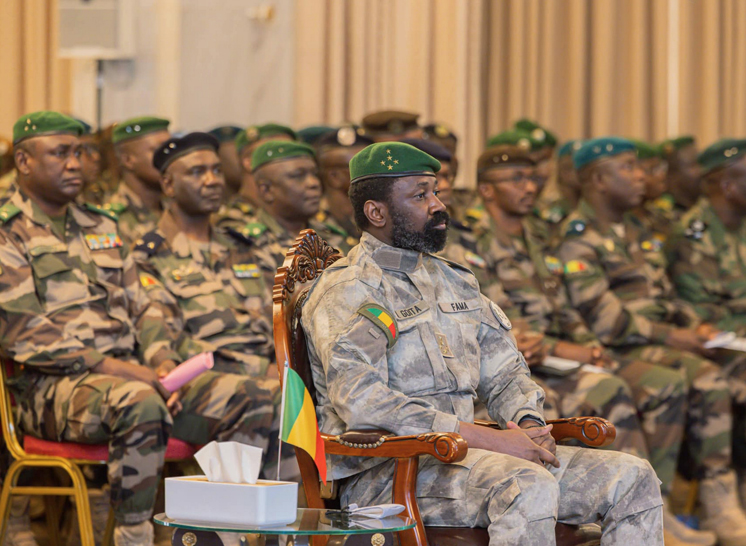
Twenty-two years after the initial national defense law, Mali has adopted a sweeping update to its security architecture. The new framework, approved by the National Transitional Council, expands its scope to include internal security, cyber defense, and comprehensive crisis management. This modernized legal structure redefines strategic decision-making, operational command, and the roles of local security actors.
The reforms aim to replace the 2004 defense law, which, despite covering military operations, internal security, and civil defense, no longer aligned with the country’s evolving security realities. General Daoud Aly Mohammedine, Minister of Security and Civil Protection, emphasized that over two decades of application and shifting threats made this overhaul essential. He also highlighted the inclusive nature of the process, noting that security stakeholders contributed extensively during preparatory discussions.
From 2004 to 2026: A framework that needed renewal
The 2004 law, though comprehensive, was limited in scope. It governed military operations, internal security, and civil defense but lacked explicit provisions for cyber threats or modern coordination mechanisms. The new reforms address these gaps by integrating cyber defense as a core component of national security. The National Security Council and the National Defense Committee now replace older structures, ensuring clearer direction and coordination under the President’s leadership.
The reforms also strengthen the unified operational command, placing it under the Chief of Staff of the Armed Forces for territorial defense. This streamlines responses to major crises, cross-border threats, or coordinated attacks. However, it does not place the National Police, Gendarmerie, National Guard, or Civil Protection under permanent military command.
Since 2022, the National Police and Civil Protection have been militarized, facilitating their integration into broader security frameworks while maintaining their public safety and emergency response roles.
Strengthening territorial administration and local engagement
The reforms prioritize three key areas: territorial administration, traditional leadership involvement in counter-terrorism, and force recruitment and equipment. This aligns with the expanded role of the Ministry of Territorial Administration and Decentralization, which now oversees civil defense, coordinates decentralized services, and mobilizes communities without turning civilians into auxiliary forces.
The goal is to create a seamless flow of intelligence and alerts from local communes to national authorities, ensuring rapid detection and response to threats. General Daoud Aly Mohammedine stressed the importance of balancing institutional efficiency with public trust.
Cyber defense takes center stage
A parallel but critical reform involves the creation of the National Agency for Information System Security (ANSSI), established in June under the 2026–2030 National Cybersecurity Strategy. The agency will coordinate responses to cyberattacks, protect critical infrastructure, and safeguard government networks and communications. This positions cyber defense as a strategic pillar of Mali’s security framework.
While cybersecurity covers broader administrative and communication networks, cyber defense focuses on protecting state infrastructure from digital threats.
Real-world testing: DDR and operational coordination
The reforms are already being tested in practice. On August 4, 254 former combatants from various armed groups were integrated into the Armed Forces after completing training in Soufouroulaye. The broader Disarmament, Demobilization, and Reintegration (DDR) initiative aims to integrate 2,000 ex-fighters and reintegrate 1,000 others socioeconomically. Though not legally tied to the new law, this process requires close collaboration between defense, security, reconciliation, and local authorities.
Success hinges on implementation
The effectiveness of these reforms will depend on execution details: application procedures, intelligence-sharing protocols, local government resources, cyber capabilities, and clearly defined responsibilities. The new framework establishes a chain of command designed for speed, coordination, and institutional trust among forces and citizens alike.