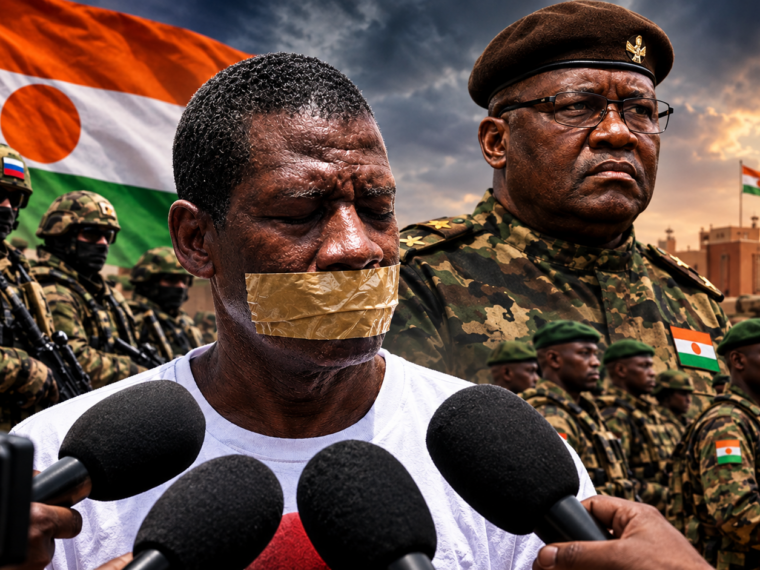
After weeks of uncertainty, Niger’s military leadership has acknowledged the detention of prominent journalist Moussa Kaka. The confirmation, made public by the Justice Minister on October 6, marks a pivotal moment in a crisis that has drawn international scrutiny and raised urgent questions about press freedom and state accountability in the country.
From disappearance to detention: the breaking silence
The journalist’s sudden disappearance on August 30, shortly after leaving the premises of Radio Télévision Saraounia in Niamey, sparked widespread concern among human rights organizations and the international community. While authorities initially provided no details, the confirmation that Kaka is alive and being held under state custody though without disclosing location, charges, or legal basis represents a critical shift in the narrative surrounding his case.
Reporters Without Borders (RSF) has called for his immediate release and full transparency, emphasizing that the lack of clarity violates both national and international standards of due process and press freedom. The organization’s stance underscores the growing pressure on the Tiani junta to justify its actions in a climate of heightened uncertainty.
A journalist at the heart of sensitive truths
Moussa Kaka’s career as an investigative journalist formerly a correspondent for RFI and director of Radio Télévision Saraounia has long positioned him at the intersection of public interest and political sensitivity. His work has scrutinized national security narratives, particularly in regions where armed groups continue to pose a grave threat. While no official explanation has linked his detention to specific revelations, the timing and context invite broader reflection on the information he may possess.
The government’s insistence on stability contrasts sharply with the persistent violence gripping Niger. Reports of military casualties, internal army strife, and equipment shortages reveal a security landscape far from the official portrayal of control. These contradictions suggest that Kaka’s potential knowledge of operational gaps or political tensions could pose an unwelcome challenge to the junta’s authority.
The Russia factor in Niger’s shifting security calculus
Another dimension of Kaka’s case involves the evolving role of external actors in Niger’s security framework. Since the August mutiny in Niamey, reports have confirmed the presence of the Russian Africa Corps a force operating under Moscow’s Defense Ministry providing direct support to loyalist troops. While framed as part of counterterrorism efforts, this partnership has fueled speculation about the junta’s priorities, particularly regarding resource allocation and protection of its own power.
Critics argue that Russian involvement extends beyond combat operations, with allegations that newly acquired military supplies are being diverted to secure the regime rather than frontline soldiers. This perceived imbalance has intensified public distrust and amplified calls for transparency, further complicating the junta’s efforts to present a unified national front.
A turning point for press freedom and state legitimacy
The detention of Moussa Kaka is no longer an isolated incident but a litmus test for Niger’s military leadership. In a nation where sovereignty and stability are frequently invoked, the failure to provide a credible explanation for Kaka’s detention despite international condemnation undermines the junta’s claims of restoring order and accountability.
As the weeks pass without clarity, the case has become emblematic of a broader crisis: one where the absence of answers speaks louder than official statements. The Tiani regime now faces a decisive moment one that will determine whether it can reconcile its narrative of control with the realities of dissent, insecurity, and the erosion of public trust. Until then, the shadow of Moussa Kaka’s detention will continue to loom large over Niger’s political future.
By Agnès Mvogo — Journaliste / Rédacteur