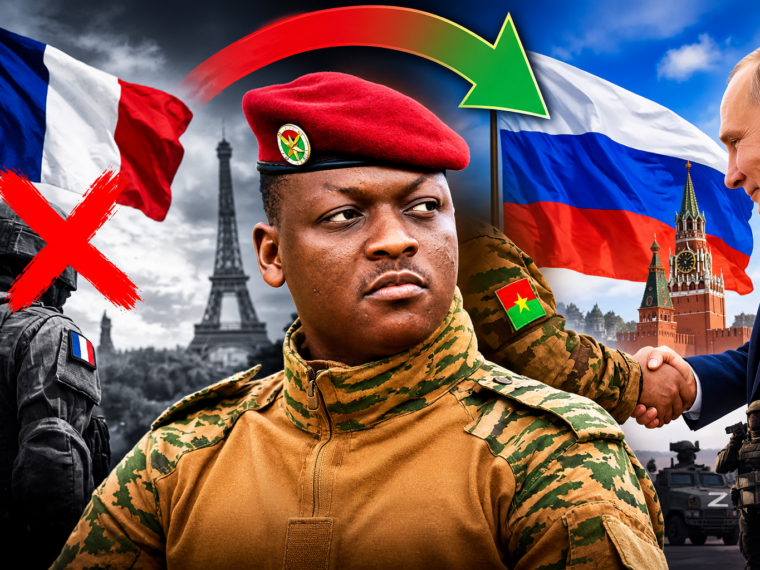
Captain Ibrahim Traoré, Burkina Faso’s transitional leader, has made a decisive break with France, marking a pivotal moment in the country’s foreign policy. In a late September interview with BF1 TV, he categorically ruled out any possibility of restoring diplomatic ties with Paris, using sharp language to criticize France’s policies toward Ouagadougou. This stance solidifies a clear shift in Burkina Faso’s diplomatic course, one that has been unfolding since Traoré’s rise to power in September 2022 a course aimed at severing ties with France and pivoting toward Russia.
From rhetoric to reality: Traoré’s uncompromising stance on France
Since assuming leadership, Traoré has consistently criticized France, while relations between Burkina Faso and France have deteriorated sharply. The expulsion of French troops, the withdrawal of diplomats, and the cancellation of key cooperation agreements have underscored this rupture. Concurrently, Burkina Faso has deepened its ties with Russia and strengthened its alliance with Mali and Niger through the Alliance of Sahel States (AES).
While Ouagadougou frames this shift as a reclaiming of national sovereignty, the move must be scrutinized beyond political speeches. True sovereignty requires more than rejecting an old partner; it demands the ability to make autonomous decisions, bolster national capabilities, and improve living conditions for citizens.
Can Burkina Faso escape external influence?
Traoré’s rejection of France has resonated with many Burkinabè, reflecting decades of resentment toward the former colonial power and frustration with unbalanced cooperation. Yet severing ties with Paris is not, in itself, a guarantee of independence. Sovereignty is measured by a country’s capacity to set its own priorities, diversify partnerships, negotiate balanced agreements, and resist external pressure regardless of its origin.
By framing the break with France as a definitive act of emancipation, the Burkinabè government risks oversimplifying a complex issue into a binary choice between two foreign powers. France is portrayed as the symbol of past dependence, while Russia is presented as the solution to that dependence. But this narrative deserves closer examination.
Russia’s role: a strategic ally or a new dependence?
The deepening partnership between Ouagadougou and Moscow represents one of the most significant shifts in Burkina Faso’s foreign policy under Traoré’s leadership. Security cooperation has taken center stage, especially as the country grapples with persistent terrorist threats. For Burkinabè authorities, diversifying military partners may be a way to strengthen national defenses after years of what they view as inadequate cooperation with France.
While Burkina Faso has the sovereign right to choose its partners, the critical question is what Ouagadougou gains from this new alliance. What are the financial, military, or economic commitments on both sides? How long are these agreements valid? What safeguards are in place to prevent foreign interference? And most importantly, how will this cooperation enhance Burkina Faso’s long-term security and stability?
The answers to these questions will determine whether the alliance with Russia strengthens Burkina Faso’s autonomy or merely replaces one form of dependence with another. Military cooperation can provide immediate support, equipment, or expertise, but its true value lies in measurable outcomes: protecting civilians, securing roads, enabling displaced persons to return, and restoring essential services in conflict zones.
Beyond declarations: measuring real progress
Rhetoric alone cannot assess the success of Burkina Faso’s new diplomatic direction. The partnership with Russia must be evaluated on its ability to deliver tangible benefits to the population. Has security improved? Are public services functioning in previously inaccessible areas? Are economic opportunities expanding? These are the indicators that will define the true impact of Traoré’s foreign policy.
It would be premature to declare the shift a strategic victory without concrete evidence of progress. Equally, it would be unjustified to assume that Russia wields undue influence over Burkina Faso’s decisions without reviewing the terms of their agreements or their implementation.
The paradox of sovereignty: breaking free or changing partners?
One of the central contradictions in Traoré’s approach lies in how sovereignty is framed in public discourse. While the government frames its actions as a rejection of Western influence, true sovereignty extends beyond military partnerships. It encompasses control over natural resources, fiscal policy, economic independence, industrial capacity, food security, and the freedom to negotiate with foreign investors.
A country may sever ties with an old partner and still remain dependent on others for military equipment, technology, financing, or trade. This interdependence is not inherently problematic, but it becomes concerning when alternative options are scarce and the country struggles to uphold its own priorities.
If Russia becomes an indispensable partner in key sectors without credible alternatives, the risk of a new form of dependence arises one that may not be recognized immediately, even as it is cloaked in the language of sovereignty.
The test of regional cooperation: can the AES deliver?
The formation of the Alliance of Sahel States (AES) uniting Burkina Faso, Mali, and Niger reflects a shared ambition to redefine regional power dynamics. The three nations emphasize their sovereignty, coordination of policies, and desire to reduce reliance on external partners. In principle, regional cooperation offers significant potential, enabling shared defense strategies, intelligence exchange, trade facilitation, and collective solutions to Sahel challenges.
Yet an alliance alone does not guarantee effectiveness. Its success must be measured by tangible outcomes: reduced attacks, safer roads, displaced persons returning home, and functioning public services in conflict zones. Economic integration must also translate into smoother trade, improved infrastructure, and support for local producers and businesses.
The AES’s sovereignty claim should be judged not only by its opposition to certain powers but by its ability to negotiate freely with multiple partners, without making hostility toward a single country the sole driver of its diplomacy.
The ultimate measure: results for the people
For the Burkinabè people, grappling with insecurity, displacement, economic hardship, and limited access to services, diplomatic shifts must translate into tangible improvements. While Traoré’s rejection of France may be a bold political statement, and the alliance with Russia may serve strategic interests, neither decision absolves the government of accountability for its performance.
The true benchmark for success lies in measurable outcomes: the safety of citizens, the continuity of public services, access to healthcare and education, job creation, and the protection of economic activities. These are the indicators that will determine whether Burkina Faso is becoming more sovereign or simply exchanging one dependency for another.
A new era of foreign policy: freedom without guarantees
By ruling out any rapprochement with France, Traoré has made it clear that Burkina Faso’s foreign policy has entered a new chapter. But this chapter raises fundamental questions about what sovereignty truly means for Ouagadougou. A truly independent nation must be free to choose its partners without being constrained by their demands. It must cultivate relationships with multiple powers while defending its own interests without becoming a pawn in another country’s strategic game.
France, Russia, and other global powers all pursue their own agendas. Burkina Faso’s alliances should not be evaluated based solely on ideological alignment with its leaders. The critical test is whether this realignment yields lasting benefits for the country and its people.
In the end, sovereignty is not proclaimed in speeches or headlines. It is proven in the ability to make free choices, negotiate without coercion, and deliver real progress for the population. That is the standard by which Burkina Faso’s bold diplomatic pivot must be judged.
By Thomas Nkoulou — Journaliste / Rédacteur