Sankara’s mausoleum sparks debate: whose memory is it anyway?
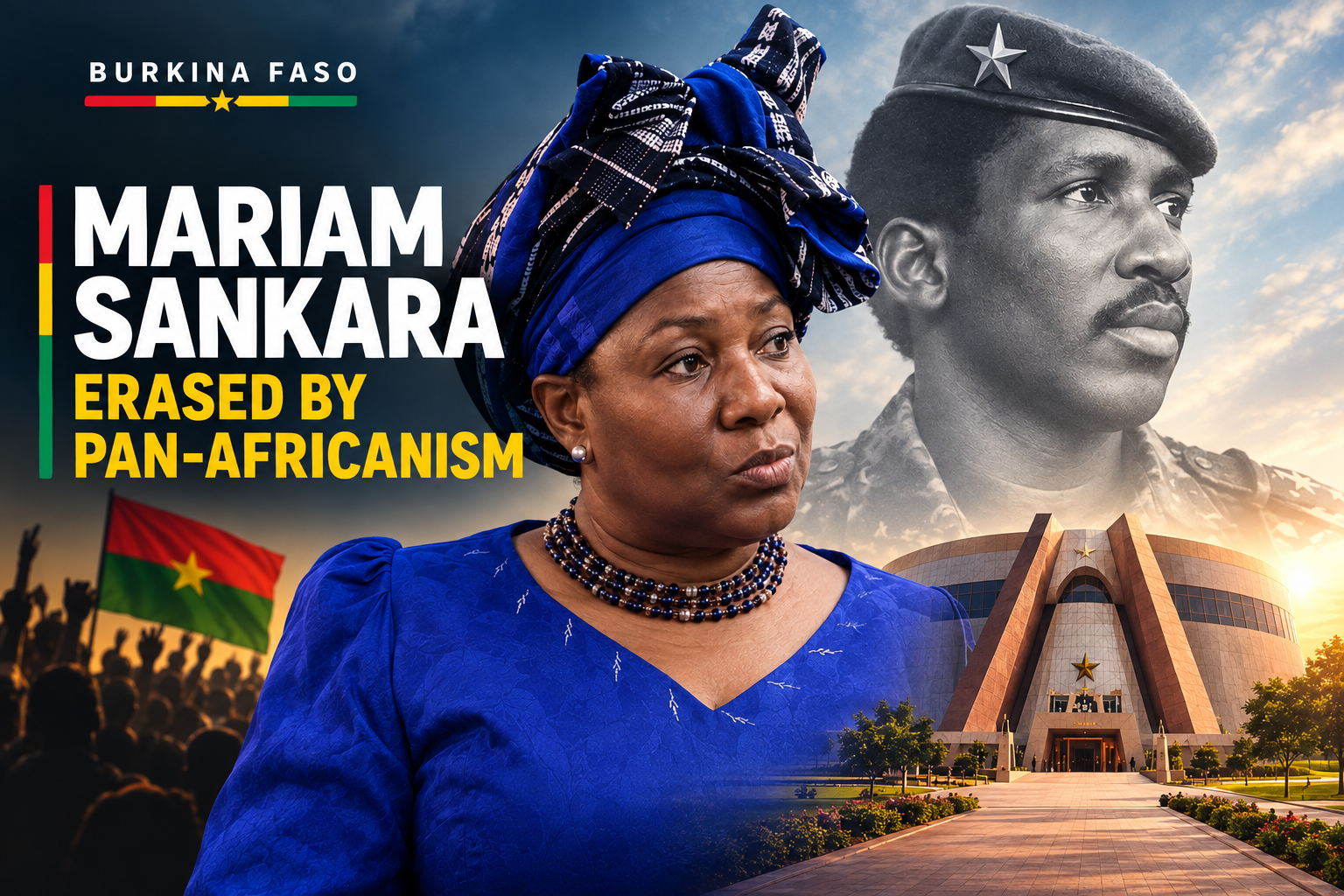
On 17 May 2025, Burkina Faso unveiled the Thomas Sankara Mausoleum in Ouagadougou with grand ceremony, marking a pivotal moment in the nation’s ongoing reckoning with its revolutionary past. Hosted at the former Conseil de l’Entente site and presided over by Prime Minister Rimtalba Jean Emmanuel Ouédraogo under the patronage of Captain Ibrahim Traoré, the event drew dignitaries from across Africa—including Senegal’s Ousmane Sonko and Chad’s Allah-Maye Halina—as well as representatives from the Alliance of Sahel States and global pan-African figures. Twenty-one cannon shots echoed through the capital as speeches, revolutionary symbolism, and Francis Kéré’s eye-shaped architectural design framed the occasion as an international tribute.
Yet amid this spectacle, one name was conspicuously absent: Mariam Sankara. Neither she nor her children attended. No speaker acknowledged the woman who bore Thomas Sankara’s name for over three decades, defended his legacy during years of exile, and sought justice for his 1987 assassination. Her silence—and absence—has ignited a profound public debate about ownership, authenticity, and the future of historical memory in post-revolutionary Burkina Faso.
The growing rift between state narrative and family voice
The mausoleum is officially billed as a vessel to “safeguard, preserve, and promote” Sankara’s political heritage. But its inauguration has exposed a deepening tension: can a nation institutionalize the memory of a revolutionary leader while sidelining those who lived closest to his truth?
Mariam Sankara’s exclusion is not new. During Blaise Compaoré’s 27-year rule—the regime that followed Sankara’s murder—she was forced into exile in Montpellier, France, denied recognition as a former first lady, and silenced for daring to speak her husband’s name. Only after Compaoré’s 2014 ouster could she return, and only in 2021 did the long-delayed trial of Sankara’s alleged assassins finally commence.
Throughout those decades of erasure, Mariam remained one of the few direct links to Sankara’s personal life and political journey. Her advocacy was not performative; it was perilous. Now, as his image adorns streets, speeches, and state monuments, her voice appears increasingly marginalised—not suppressed, but politely bypassed.
A legacy reshaped across three regimes
The memorial project predates the current administration. Officially launched on 2 October 2016 under President Roch Marc Christian Kaboré, it evolved through shifting political tides. Under Kaboré, Sankara’s rehabilitation served both genuine commemoration and strategic nostalgia—especially as the government flirted with Compaoré’s potential return.
With Captain Ibrahim Traoré’s rise, Sankara’s symbolism was elevated further: from national hero to doctrinal cornerstone of a new revolutionary ethos. Initially invoked to legitimise a coup-born government, his legacy has since been subtly distanced as the regime consolidates power—first claiming kinship with Sankara, then urging critics to stop comparing the two.
This evolution reflects a broader transformation: Sankara is no longer just a murdered president or 1983 revolutionary leader. He is now a curated national icon, his memory organised, staged, and enshrined by the state.
Family objections and the politics of burial
The Sankara family never endorsed the 2023 reburial or the 2025 mausoleum inauguration. In a February 2023 statement, Mariam Sankara, her sons, and Thomas’s siblings described feeling “crushed by the force of public authority.” They opposed interring his remains at the very site of his assassination, arguing it was too charged with trauma to serve as a place of peace.
Instead, they proposed alternatives: Dagnoën Cemetery, Jardin de l’Amitié, or Jardin Yennenga—spaces they believed could unite rather than divide. They also urged that the assassination site remain a preserved historical landmark, not a burial ground. Their appeals went unanswered. The reburial proceeded on 23 February 2023 without them.
This unresolved dispute underscores a symbolic fracture: the state controls the public narrative, while the family contests its execution. Whether Sankara is weaponised for legitimacy or sanctified for unity, the outcome for his kin remains consistent—exclusion from decisions that most intimately affect them.
Pan-Africanism and the cost of iconography
The irony is stark. Thomas Sankara championed sovereignty, dignity, and resistance to domination. Yet his own family claims to have faced top-down imposition when it came to honouring his memory. Today, as pan-African leaders invoke his name from Dakar to Khartoum, few address the family’s concerns about how that legacy is being shaped.
Pan-African solidarity should extend beyond ceremonial homage. It must include ethical engagement with those who safeguarded Sankara’s memory when doing so carried risk. Otherwise, the real man—the husband, father, and comrade—fades behind the myth. And with him fades Mariam Sankara, who stood guard when few dared.
What comes next for Sankara’s contested legacy?
The question is no longer whether Burkina Faso honours Thomas Sankara—it clearly does, with monuments, rituals, and rhetoric. The deeper issue is whether the nation can reconcile its official memory with the lived experiences of those who knew him best.
A truly reconciled memory isn’t measured by cannon salutes or foreign dignitaries, but by a state’s willingness to listen to grief that predates celebration. On that front, the Sankara file remains open—and the debate far from settled.